


In Alzheimer’s disease research, APOE4 is often described as the high-risk allele, while APOE2 is described as protective. That shorthand is useful, but it can also mislead.
APOE4 is not simply a “bad gene,” and APOE2 is not simply a “good gene.” Many APOE4 carriers do not develop dementia, and some APOE2 carriers have a lipid handling disorder.
APOE alleles reflect biological tradeoffs. A variant that helps in one environment, tissue, or life stage may harm in another.
That is why the question sounds easier than it is:
If APOE2 protects against Alzheimer’s disease, why don’t we give APOE2 to APOE4 carriers?
The answer is that APOE2 is not a vitamin, supplement, or simple replacement part. APOE is a lipid transport protein, receptor ligand, immune modulator, and brain-cell signaling molecule. Its effects depend on where it is made, which cell makes it, how it is lipidated, when it is delivered, and what disease stage is already present.
Not a Good or a Bad Gene Copy
APOE is a lipid transport gene with three common alleles: APOE2, APOE3, and APOE4. In many large datasets, APOE3 is the most common allele, roughly 75–80%, while APOE4 is about 10–15% and APOE2 about 5–10%, with variation by ancestry and population. In genotype terms, APOE3/3 is the most common, often present in about two-thirds of people [1].
APOE4 increases late-life Alzheimer’s risk, but human data suggest it may have carried advantages in environments where infection, undernutrition, and reproduction shaped survival more strongly than late-life dementia.
In the Tsimane, a natural fertility population with high infectious burden, a study of 795 women found that APOE4 carriers had about 0.3 to 0.5 more children than APOE3 homozygotes, while APOE4 homozygotes had about 1.4 to 2.1 more children [2]. In a Brazilian shantytown cohort of 72 children followed from birth, APOE4 carriers appeared more resilient to the long-term cognitive effects of heavy early-childhood diarrhea [3]. Several studies also describe amyloid-beta as an antimicrobial-like peptide that can inhibit microbial growth through membrane disruption or microbial entrapment [4].
These studies do not prove that APOE4 is beneficial. They support a more careful idea: what helps early-life survival may not help the aging brain.
APOE2 also has tradeoffs. APOE2 is associated with lower Alzheimer’s risk and, in some studies, longevity. Key to how it works, APOE2 binds poorly to the LDL receptor. This property may explain why about 5–10% of APOE2 homozygotes develop type III hyperlipoproteinemia, with accumulation of triglyceride-rich remnant particles [4]. APOE2 has also been associated with increased risk of cerebral amyloid angiopathy and selected neurological disorders [5].
So the goal is not to replace a “bad” allele with a “good” allele. The goal is to identify which APOE2 functions protect the aging brain — lipidation, amyloid handling, synaptic support, vascular effects, or microglial signaling — and reproduce those functions without creating APOE2-related complications.
What APOE2 Does Differently from APOE4
APOE is best known as a lipid carrier. In the brain, APOE helps move cholesterol and phospholipids between cells. This is essential because neurons depend on glial cells to help maintain membranes, synapses, repair programs, and lipid balance.
APOE2 differs from APOE3 and APOE4 at key amino acid positions. One important consequence is weaker binding to the LDL receptor (LRP1). In some lipid-handling contexts, APOE2 can therefore behave like a partial loss-of-function variant.
But in the brain, APOE2-containing lipoprotein particles may be more lipidated than APOE3 or APOE4 particles. More lipidated particles may better support lipid transport, synaptic maintenance, amyloid plaque seeding, and amyloid clearance [4].
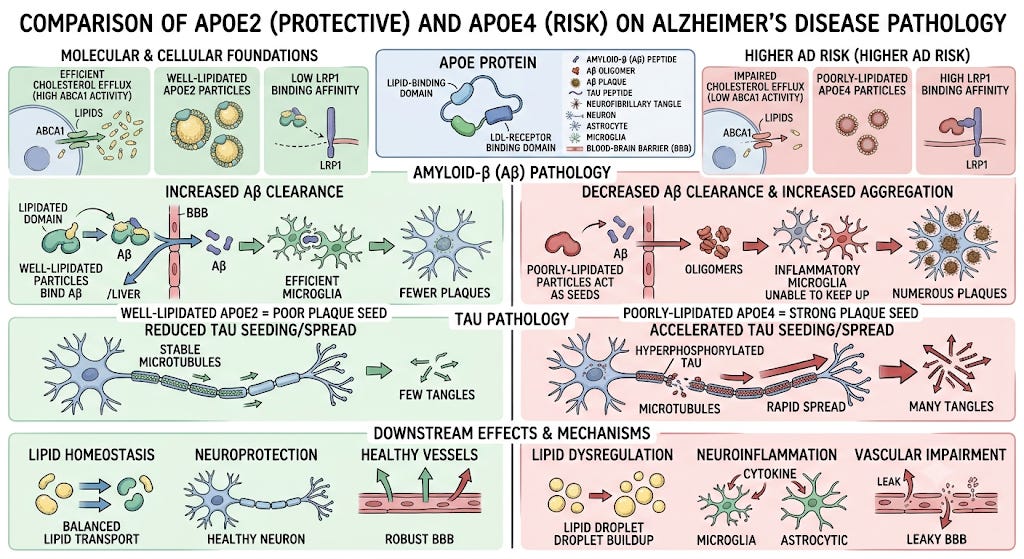
But there is the APOE2 paradox:
In the periphery, APOE2 can impair remnant clearance. In the brain, APOE2 may create a more protective lipidated particle.
That is why therapeutic design has to be precise.
APOE2-Associated Longevity Involves Lipid Handling, Not Just Alzheimer’s Pathology
APOE2’s link to longevity may not simply reflect lower Alzheimer’s pathology. In an analysis of NACC clinical records, carrying APOE4 had a similar effect on survival independent of AD pathology. Similarly, APOE2 had a protective effect on survival independent of amyloid and tau pathology-Figure 2 [6]. I have discussed before why amyloid and tau do not fully explain the clinical syndrome of AD, and here is where lipids become interesting.
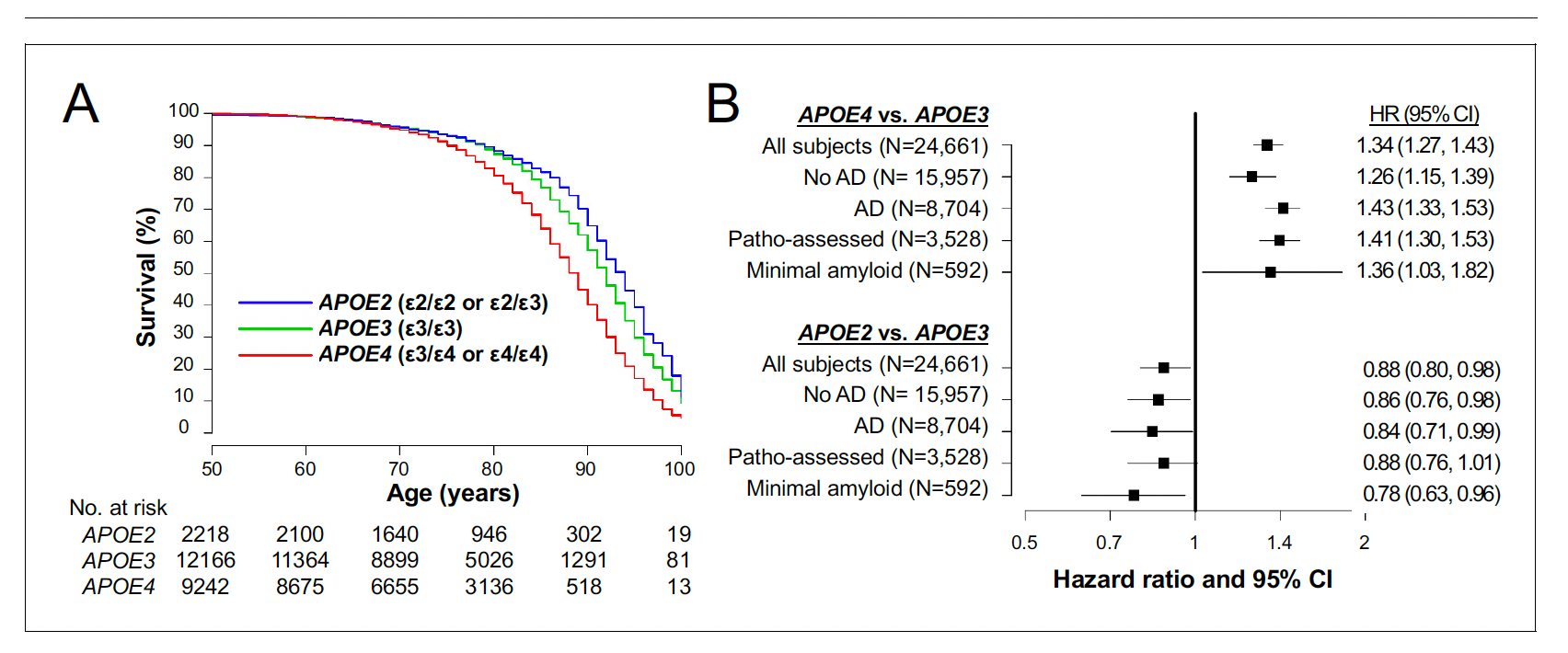
In the same eLife study, APOE2-targeted replacement mice lived longer in a model that did not overexpress mutant APP or tau and did not show Alzheimer-like amyloid or tau deposition. In 118 mice, median survival was 911 days for APOE2, 825 days for APOE3, 753 days for APOE4, and 738 days for Apoe knockout [6].
This same study linked APOE2 to preserved activity and lipid metabolism during aging. The authors reported associations among activity, apoE protein, HDL-cholesterol, and triglycerides, and suggested that higher HDL-cholesterol and triglyceride levels regulated by apoE2 might contribute to APOE2-mediated longevity [6]. These findings may offer interesting insights into how Obicetrapib may affect AD biology.
This matters because APOE2 may influence aging through lipid transport and brain-body metabolism, not only through amyloid and tau. An APOE2 therapy should therefore ask not just whether plaques go down, but whether lipid handling, vascular integrity, brain metabolism, learning, and resilience move in the right direction.
The Brain Has Its Own APOE System
One major reason we cannot simply give APOE2 by mouth or IV is that the body and brain have largely separate APOE pools.
A classic liver transplantation study showed that after liver transplant, the APOE phenotype in plasma changed almost completely to match the donor liver. But the APOE phenotype in cerebrospinal fluid did not change [7].
Liver APOE does not simply become brain APOE.
The liver supplies most plasma APOE. The brain makes APOE locally, mainly through astrocytes, with contributions from microglia, vascular mural cells, choroid plexus, and stressed neurons [4].
So oral APOE would likely be digested like other proteins. IV APOE may mostly act in the periphery, where it could affect triglycerides, remnant lipoproteins, vascular biology, or inflammation. But it may not meaningfully change APOE biology inside the brain.
The therapeutic problem is not just what to deliver.
It is where to deliver it, and whether APOE is properly lipidated.
AAV Gene Therapy: Silence and Replace
One promising approach is CNS gene therapy.
In APOE4 carriers, the ideal intervention may not be adding APOE2 alone. It may require two steps:
Silence APOE4. Replace with APOE2.
This makes biological sense because APOE4 may not simply represent loss of protection. APOE4 may also have toxic gain-of-function effects involving lipidation, amyloid aggregation, amyloid clearance, synaptic injury, mitochondrial function, blood-brain barrier integrity, and neuroinflammation.
A recent AAV “silence-and-replace” strategy used microRNAs to suppress endogenous APOE4 while adding a modified APOE2 gene designed to resist that silencing [8].
The idea is elegant: reduce the high-risk APOE4 signal and shift the local CNS APOE environment toward APOE2.
But delivery remains difficult. In mice, APOE AAV studies often bypass the blood-brain barrier by direct stereotaxic brain injection. In the APOE4 silence-and-replace study, investigators drilled burr holes and injected AAV.S2 vectors bilaterally into the hippocampus. That is very different from giving a drug by mouth or IV, and it highlights the central challenge for human translation: how to deliver APOE2 safely, broadly, and to the right CNS cells without direct regional injections into every vulnerable brain area.
Many AAV vectors preferentially transduce neurons. Yet most endogenous brain APOE is made by astrocytes. That mismatch matters. If a therapy causes neurons to make APOE2, is that equivalent to astrocytes or microglia making APOE2?
Likely not.
Cell Type Matters
This may be the most important concept.
APOE2 made by a neuron may not be the same as APOE2 made by an astrocyte or microglia.
Astrocyte-derived APOE participates in lipid transport, synaptic maintenance, cholesterol handling, and neuronal support.
Microglial APOE may be more closely linked to immune activation, plaque-associated responses, TREM2 biology, phagocytosis, damaged-neuron clearance, and disease-associated microglial states.
Cell type also affects APOE processing. APOE made in different cells may differ in lipidation, secretion, receptor interactions, and post-translational modification [8].
So simply measuring “more APOE2 in the brain” may not tell us whether the right biology has been restored.
The future may require cell-specific APOE2 expression.
Current Clinical Translation
The leading clinical example is LX1001, an investigational AAVrh.10-based gene therapy designed to deliver human APOE2 into the central nervous system of APOE4 homozygotes with Alzheimer’s disease [9].
The Phase 1/2 study tests one-time intrathecal administration of AAVrh.10hAPOE2 in APOE4 homozygotes with mild cognitive impairment or dementia due to Alzheimer’s disease. A long-term follow-up study is also underway [9,10].
Intrathecal delivery means placing the therapy into the cerebrospinal fluid, the fluid that surrounds the brain and spinal cord. This brings an AAV vector closer to the CNS than an IV infusion, but it does not guarantee that the right brain cells will express APOE2. After intrathecal delivery, APOE2 may be expressed by cells reached from the CSF space — including meningeal, ependymal, choroid plexus, spinal, or some brain parenchymal cells depending on the vector. The key question is whether this reproduces the biology that matters most for Alzheimer’s disease: APOE made by astrocytes and microglia, properly lipidated, secreted at the right level, and active in the brain regions most vulnerable to disease
Interim topline results reported 15 dosed participants, dose-dependent APOE2 detection in CSF, general tolerability, and favorable movement in some amyloid and tau biomarkers [11].
These findings support continued study, but they are not proof of clinical efficacy.
The core translational questions remain:
Can APOE2 be delivered safely to the CNS?
Can APOE2 be expressed durably at meaningful levels?
Does it improve amyloid, tau, lipid, vascular, or inflammatory biology?
Does it avoid vascular, inflammatory, lipid, lysosomal, or immune toxicity?
Does it slow cognitive and functional decline?
What Would Success Look Like?
The benchmark for success cannot be “we detected APOE2.” That is target engagement, not disease modification.
A successful APOE2 therapy would need several layers of evidence.
First: safety. No unacceptable inflammation, immune response, edema, hemorrhage, vascular injury, or accelerated neurodegeneration.
Second: target engagement. APOE2 should appear in CSF or other CNS-linked measures in a dose-responsive and durable way.
Third: biological correction. The therapy should improve APOE lipidation, lipid transport, amyloid handling, tau-related injury, synaptic biology, glial function, or vascular integrity.
Fourth: clinical effect. It should slow worsening on cognition, function, MRI atrophy, tau PET, amyloid PET, CSF biomarkers, or plasma biomarkers.
The hardest endpoint is the one patients care about most:
Do people think, remember, function, and live independently longer?
That is the real bar.
The Liposome Cautionary Tale
A recent liposome-based APOE2 study is important because it complicates the simple story.
The study used brain-targeting liposomes to deliver APOE2 plasmid material in an amyloid mouse model. APOE2 delivery produced some potentially favorable transcriptional signals related to neuronal development and synaptic pathways [12].
But it also increased soluble amyloid-beta, including oligomeric forms, and worsened neurite dystrophy [12].
That distinction matters.
Lowering plaque burden is not automatically the same as lowering toxicity. Some soluble amyloid species may be more synaptotoxic than deposited plaque.
So “APOE2 reduces plaques” is not enough.
We need to ask:
What happens to soluble amyloid?
What happens to synapses?
What happens to neurites?
What happens to microglia?
What happens over time?
Prevention Is Not Treatment
A person born with APOE2 has decades of APOE2 biology. Their brain develops and ages with different lipidation, receptor binding, amyloid handling, synaptic support, vascular biology, and immune tone.
That is not the same as giving APOE2 at age 70 after amyloid plaques, tau pathology, vascular injury, or neuroinflammation are already present.
APOE2 may be most powerful as preventive biology. It may reduce amyloid accumulation, improve lipid transport, support synapses, or shape microglial responses before pathology is advanced.
But once amyloid burden is high, adding APOE2 could have different effects. It may mobilize amyloid into soluble species, alter glial lipid handling, or interact with tau and vascular disease in ways we do not yet understand.
This does not mean APOE2 therapy cannot work in treatment.
It means disease stage matters.
One APOE2 strategy may not fit young APOE4 carriers, preclinical amyloid-positive carriers, mild cognitive impairment, established dementia, vascular comorbidity, amyloid-dominant disease, or tau-dominant disease.
The Ethical Question
APOE2 gene therapy also raises some ethical issues.
AAV-based gene therapy is designed to be long-lasting. That makes the risk-benefit calculation different from taking a pill that can be stopped.
The prevention question is harder. What level of risk would justify CNS gene therapy in a cognitively normal APOE4 homozygote? Amyloid positivity? Tau positivity? Plasma p-tau? Family history? Age?
Equity also matters. Genetic testing, biomarker screening, lumbar puncture, gene therapy delivery, and long-term monitoring may not be equally accessible.
The ethical standard should be high:
Clear risk disclosure, careful genetic counseling, long-term follow-up, transparent uncertainty, fair access, and a strict distinction between prevention and treatment.
So Why Aren’t We Giving APOE2 to APOE4 Carriers?
Because APOE2 is not simply good, and APOE4 is not simply bad.
We are not replacing a missing vitamin.
We are trying to reprogram a complex lipid-immune-neurodegenerative pathway inside the brain.
APOE genotypes teach us that Alzheimer’s risk is modifiable. It points toward protective mechanisms involving lipidation, receptor binding, amyloid handling, synaptic support, vascular biology, microglial function, and lipid metabolism.
But APOE2 is not a simple replacement part for APOE4.
The future is likely precision APOE biology: the right APOE function, in the right brain compartment, in the right cell type, at the right dose, and at the right disease stage. This is where downstream mechanisms become interesting. Can we lipidate APOE3 and APOE4 to behave like APOE2? Can we block APOE4-accentuated neuroinflammation, like APOE2?
APOE2 may or may not be the answer by itself.
It will offer us important clues.
Key Takeaways
APOE4 and APOE2 are not simply bad and good alleles. They likely reflect biological tradeoffs.
APOE2 is associated with lower Alzheimer’s risk and longevity, but it is not universally benign.
APOE2 longevity may involve lipid metabolism, not only amyloid and tau.
Peripheral APOE and brain APOE are largely separate pools, and oral or IV APOE2 is unlikely to reproduce brain APOE2 biology.
Cell type matters. Astrocyte, microglial, and neuronal APOE2 may not have the same effects.
AAV silence-and-replace strategies are promising, but delivery and cell targeting remain major challenges.
Reducing plaques is not enough if soluble amyloid oligomers or neurite injury increase.
Prevention and treatment may require different APOE2 strategies.
The future is likely precision APOE biology, not simply “give APOE2.”
References
Farrer LA, Cupples LA, Haines JL, et al. Effects of age, sex, and ethnicity on the association between apolipoprotein E genotype and Alzheimer disease. JAMA. 1997;278(16):1349–1356.
Trumble BC, Stieglitz J, Blackwell AD, et al. Apolipoprotein-ε4 is associated with higher fecundity in a natural fertility population. Science Advances. 2023.
Oria RB, Patrick PD, Zhang H, et al. APOE4 protects the cognitive development in children with heavy diarrhea burdens in Northeast Brazil. Pediatric Research. 2005.
Moir RD, Lathe R, Tanzi RE. The antimicrobial protection hypothesis of Alzheimer’s disease. Alzheimer’s & Dementia. 2018.
Li Z, Shue F, Zhao N, Shinohara M, Bu G. APOE2: protective mechanism and therapeutic implications for Alzheimer’s disease. Molecular Neurodegeneration. 2020;15:63.
Shinohara M, Kanekiyo T, Tachibana M, et al. APOE2 is associated with longevity independent of Alzheimer’s disease. eLife. 2020;9:e62199.
Linton MF, Gish R, Hubl ST, et al. Phenotypes of apolipoprotein B and apolipoprotein E after liver transplantation. Journal of Clinical Investigation. 1991;88(1):270–281.
Karan KR, Hackett NR, Crystal RG. Adeno-associated virus-mediated central nervous system gene transfer to suppress Alzheimer’s disease high-risk APOE4 variant and replace with protective APOE2. Human Gene Therapy. 2026.
ClinicalTrials.gov. Gene Therapy for APOE4 Homozygote of Alzheimer’s Disease. NCT03634007.
ClinicalTrials.gov. Long-Term Follow-up of Gene Therapy for APOE4 Homozygote Alzheimer’s Disease. NCT05400330.
Johnson K, et al. Topline results from Phase 1/2 AAV gene therapy (LX1001) in APOE4/4 homozygotes with Alzheimer’s disease. Alzheimer’s & Dementia. 2025.
Wang N, Parsons TM, Ren Y, et al. Brain-targeting liposome-based APOE2 gene delivery exacerbates soluble amyloid-β accumulation in AppNL-G-F mice. Heliyon. 2024;10:e39607.
Great breakdown of the biology. I specifically enjoyed learning about the distinction between peripheral and brain apoE. On a whole I think you did a great job showing me pluses and minuses. One thing I keep taking away from these targeted interventions is that there are pluses and minus for all things and that we're going to all die from something. At this point in my life I would not take something to alter a gene expression in hopes of avoiding one type of death and possibly increasing another
Thank you for this review. What is your view of the further pipeline of Lexeo and possibly voyager therapeutics of using e4 silence/ e4 ( Christchurch) transfection in homozygotes? The voyager capsid iv one time delivery is said to be not liver toxic and to be brain focussed in delivery. Also perhaps ribozyme / rna level re gene engineering to transform e4 to e3 , say in homozygotes first , are another option as per ezenomics (Korean company Roche licensed/ agreement?
There is an important general parallel with huntingdons similar gene research eg the history up till the latest uniqure . In HD the patient community was *globally* enrolled in clear biological tracking programs allowing researchers access to data. The community was trusted to choose themselves to be brave and drive therapy way faster than traditionally thought possible as they better than anyone knew the fate that awaited them. People with HD are actively involved. As a result therapies now launching like uniqure and Skyhawk therapeutics oral splice modulator is now looking very good. Will these change outcomes? Not yet clear but looking hopeful.
If a gene therapy for example changes the trajectory instead of thinking how will a 70 year old cope with this maybe we should think about the future where it rolls out in 50 year olds, because we learnt from brave consenting 70 year olds? Getting therapies that change the outcomes for pre- symptomatic people - so they never have to face what the current generations do - that seems so important. I do wonder if the medical and research community can go a lot faster in the most at risk group e4/4 in similar ways. The average time to any new drugs of ~15 years(?) is I feel unacceptable and the top down model has to change. That to me is the most ethical approach , responding to your comment. Of course early treatments are expensive and inequitable, but do get much cheaper and accessible. We can be potentially immobilised by thinking of every possible complexity or get on with trying intelligently and thoughtfully in collaboration with the communities involved to speed progress up. HD is a good example. Manhattan project is another.
Strategic focussed fast moving start-up culture today is yet another however imperfect.