


Hearing loss is usually thought of as a problem of the ears. Conversations in restaurants become harder to follow, the television gets louder, and people begin asking others to repeat themselves.
But hearing loss has also emerged as one of the most consistent potentially modifiable risk factors associated with dementia.
The 2024 Lancet Commission included hearing loss among 14 potentially modifiable dementia risk factors and estimated that, under the assumptions of its model, hearing loss accounts for roughly 7% of dementia cases at the population level.[1]-Figure below:
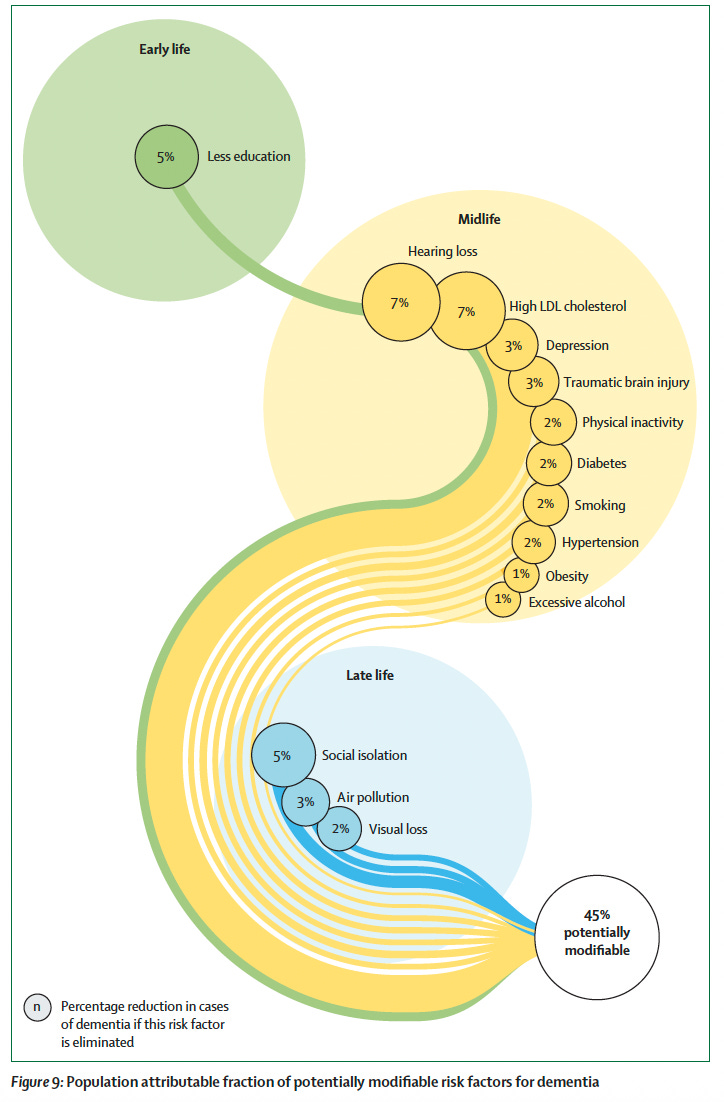
That number needs careful interpretation. It does not mean that hearing loss causes 7% of dementia or that treating hearing loss would prevent 7% of cases. A population-attributable fraction depends both on how common a risk factor is and how strongly it is associated with disease, while also making assumptions about causality.
The more interesting question is biological:
What do years of degraded hearing do to the brain, and could that burden matter more in someone already vulnerable because of APOE4?
Special thanks to Dr. Janet Choi, an ENT physician-scientist and expert in hearing loss and dementia, for taking the time to review this post and share her thoughtful perspective.
Hearing is a brain task
The cochlea in the inner ear converts sound into neural signals, but hearing does not end at the ear.
In a noisy room, the brain must separate one voice from competing sounds, direct attention to that voice, reconstruct incomplete information, and connect what is heard with language and memory.
When the auditory signal becomes degraded, the brain has to work harder.
This is the cognitive-load hypothesis: more mental resources are used to understand speech, potentially leaving fewer resources available for other cognitive tasks.[2]
That explains why hearing loss can affect performance in the moment. It does not fully explain why hearing loss might be associated with dementia many years later.
Long-term hearing loss may also alter brain networks and reduce social and cognitive stimulation. Communication becomes harder, social interactions require more effort, and some people gradually withdraw from activities they previously enjoyed.
But there may also be more direct effects on memory systems.
Hearing and memory are connected
The auditory cortex, which processes sound, is connected with structures in the medial temporal lobe involved in memory, including the entorhinal cortex and hippocampus.
The hippocampus is central to forming and retrieving memories. The entorhinal cortex acts as an important interface between the hippocampus and the rest of the cerebral cortex.
These systems communicate with each other.
Experimental studies have shown that the entorhinal cortex can influence how auditory memories are formed in the auditory cortex.[11,12] Human studies also show coordinated activity between auditory cortex and hippocampus when people hold sounds in memory.[13]
More direct recordings from the human brain suggest that this communication can run in both directions: information travels from the auditory cortex toward the hippocampus during encoding and can flow back toward the auditory cortex during memory replay.[14]
This makes hearing and memory parts of an interacting network rather than completely separate systems.
Animal studies also show that auditory deprivation can alter synaptic plasticity, meaning the ability of connections between neurons to strengthen or weaken with experience, within the hippocampus.[15]
A 2024 study by Pan and colleagues pushed this further. In an Alzheimer mouse model, experimentally induced hearing loss worsened memory, hippocampal synaptic function, and amyloid pathology. Restoring GDF1 signaling improved several of these abnormalities.[3]
These findings do not prove that hearing loss causes Alzheimer disease in humans. But they provide a plausible biological route through which chronic hearing loss could affect brain systems involved in memory.
Not all hearing problems are the same
A key distinction is whether the problem is mainly in the ear or in the brain’s processing of sound.
First, let’s introduce these two hearing tests:
A pure-tone audiogram is the standard hearing test in which tones of different pitches and loudness are played through headphones. It measures the quietest sounds a person can detect and helps identify peripheral hearing loss, which usually arises from the ear and cochlea.
A speech-in-noise test asks whether someone can understand speech when background noise is present. That task depends not only on the ear, but also on attention and higher-order auditory processing.
This distinction matters because typical age-related high-frequency hearing loss is usually peripheral, while difficulty understanding speech in a noisy environment can also reflect changes in central brain networks.
A 2024 review led by Suji Hong and colleagues notes that Alzheimer-related changes may affect higher-order sensory association regions before basic sensory detection is severely impaired. In other words, a person may still detect sounds reasonably well but have increasing difficulty interpreting complex auditory information.
That means poor speech-in-noise performance can have two possible interpretations.
It may be the consequence of long-standing hearing loss.
Or it may sometimes be an early sign that neurodegeneration is already affecting auditory processing.
Both possibilities need to be considered.
What do human studies show?
One of the landmark studies came from the Baltimore Longitudinal Study of Aging.
Lin and colleagues studied 639 adults aged 36 to 90 who were free of dementia when their hearing was measured. Over almost 12 years, 58 developed dementia.[4]
Risk increased as hearing worsened. Each 10-decibel deterioration was associated with about a 27% increase in dementia risk. Mild hearing loss was associated with roughly twice the risk of dementia, and moderate hearing loss with about three times the risk.[4]
The dose-response pattern was important.
But this was an observational study. Hearing loss could contribute to dementia, both conditions could share common causes, or hearing difficulty could sometimes reflect disease already developing in the brain.
The Health ABC Study later found a similar association in adults aged 70 to 79 followed for about nine years.[5]
A much larger UK Biobank study of 82,039 participants used a speech-in-noise test and again found that poorer performance predicted later dementia.[6]
The 2024 Lancet Commission combined six studies totaling approximately 666,000 people. Overall, hearing loss was associated with about a 37% higher rate of subsequent dementia.[1]
But the size of that association varied considerably between studies. So the direction of the relationship is fairly consistent, while the exact magnitude is not.
Timing matters
Hearing loss measured at age 50 and followed by dementia at 75 is different from hearing difficulty first appearing at 78, shortly before dementia is diagnosed.
The first pattern is more consistent with hearing loss potentially contributing to later disease.
The second raises the possibility of reverse causation: early neurodegeneration may already be impairing the brain’s ability to process sound.
This is particularly relevant because Alzheimer pathology begins many years before dementia becomes clinically obvious.
Broome, Dening, and colleagues therefore emphasize that late-life auditory difficulty can sometimes be a harbinger of neurodegeneration, rather than purely a cause of it.[2]
We also do not yet know precisely how risk varies with the severity or duration of hearing loss. Twenty years of mild hearing loss may not be biologically equivalent to several years of severe hearing loss.
Severity, duration, and age at onset may all matter.
Could tau be part of the connection?
Some human biomarker studies suggest that auditory dysfunction may be more closely associated with tau pathology than with amyloid.
Tau is a protein that normally helps stabilize neurons but accumulates abnormally in Alzheimer's disease.
Hong and colleagues summarize studies linking poor hearing performance with higher tau levels in cerebrospinal fluid or greater tau deposition in medial temporal regions involved in both memory and auditory processing.
One possibility is that altered neural activity during difficult listening interacts with brain regions already vulnerable to tau-related damage.
This is an interesting hypothesis, but it remains associative. We do not know that hearing loss causes tau accumulation in humans.
Where does APOE4 fit?
A useful way to think about APOE4 is not that it creates a continuously damaged brain, but that it may reduce resilience when an additional stressor appears.
We have discussed a similar idea in previous posts with inflammation, alcohol, high cholesterol, sleep, and other modifiable risk factors.
Hearing loss could represent another potential second hit.
APOE4 affects lipid transport, synaptic repair, inflammatory responses, vascular biology, and resilience to Alzheimer pathology. Hearing loss may simultaneously increase neural workload and alter activity in auditory and memory networks.
The question is therefore not only whether APOE4 and hearing loss independently increase dementia risk.
The biology is plausible.
The epidemiology is less clear.
Does APOE4 actually strengthen the association?
A recent Framingham Heart Study analysis included 935 adults aged 60 or older, followed for 15 years.[7]
Hearing loss was associated with increased dementia risk overall. Among APOE4 carriers, at least slight hearing loss was associated with an estimated 2.86-fold greater dementia risk compared with normal hearing.[7]
That result is consistent with a second-hit model.
But the APOE4 subgroup was relatively small, and the confidence interval around the estimate was wide, so the result needs replication.
A much larger 2026 UK Biobank study examined 80,287 adults aged 40 to 69 with genetic data and speech-in-noise testing. During follow-up, 1,086 dementia cases were identified.[8]
Hearing impairment predicted dementia in people both with and without APOE4, but there was no clear evidence that APOE4 carrier status made the link stronger.
UK Biobank has much greater statistical power, but dementia is identified largely from routine medical records rather than repeated specialist cognitive assessments. Framingham is smaller but provides deeper longitudinal characterization.
The most defensible conclusion today is:
Hearing loss is associated with dementia risk regardless of APOE4 status. APOE4 may amplify that association in some populations, but this has not yet been consistently demonstrated.
Can treating hearing loss change cognition?
The most important randomized trial is ACHIEVE.
ACHIEVE randomized 977 adults aged 70 to 84 with untreated mild-to-moderately severe hearing loss to either a comprehensive hearing intervention or a health-education control program and followed them for three years.[9]
Across the full study population, hearing treatment did not significantly slow cognitive decline.
But ACHIEVE included a prespecified subgroup of participants from the ARIC cardiovascular cohort who were older and had more dementia risk factors. In that higher-risk group, hearing intervention was associated with slower cognitive decline.[9]
That result is interesting because it raises the possibility that hearing treatment may matter more in people who are already biologically vulnerable.
But the overall trial was negative, so we cannot say that hearing aids prevent dementia.
There is also an important timing issue. Treatment began between ages 70 and 84. If hearing loss affects dementia risk through decades of altered auditory input, treating it at 75 may not answer what would happen if treatment began at 50 or 60.
What should an APOE4 carrier do?
There is currently no APOE4-specific hearing-screening guideline.
But establishing hearing status in midlife is reasonable.
WHO guidance recommends hearing screening beginning at age 50, approximately every five years through age 64, and every one to three years from age 65 onward.[10]
Testing should happen sooner if there is difficulty following conversation, trouble understanding speech in noisy environments, increasing television volume, tinnitus, significant noise exposure, or a noticeable change in hearing.
If symptoms mainly involve difficulty hearing in noise despite a relatively normal audiogram, speech-in-noise testing may be particularly useful.
An abnormal hearing test does not always mean hearing aids
The next step depends on the cause.
Some forms of hearing loss are reversible. Impacted earwax, middle-ear fluid or infection, eustachian-tube dysfunction, and other middle-ear disorders can impair hearing and may improve with treatment.
Medication history and noise exposure also matter because some drugs and repeated excessive noise can damage hearing.
Sudden hearing loss, particularly in one ear, requires prompt medical assessment. Asymmetric or rapidly progressive hearing loss also deserves further evaluation.
Typical age-related hearing loss is usually sensorineural, involving the inner ear or auditory pathway. This generally cannot be medically reversed, but its functional consequences can often be reduced with hearing aids, assistive listening technologies, communication strategies, and audiologic follow-up.
What remains unanswered?
The major questions are now fairly clear.
Which matters most: peripheral hearing loss, central auditory processing difficulty, or both?
How do severity, duration, and age at onset combine to influence risk?
Does APOE4 truly make hearing loss more harmful?
Does tau biology help connect hearing loss with Alzheimer's disease?
And does treating hearing loss in midlife alter long-term brain aging?
What we do not yet have is proof that treating hearing loss prevents Alzheimer's disease.
Take-home messages
Hearing loss is consistently associated with greater dementia risk, but association does not prove causation.
Hearing and memory systems are biologically connected, and chronic auditory deprivation may affect networks involved in memory and plasticity.
Peripheral hearing loss and central auditory dysfunction are different. Difficulty understanding speech in noise may sometimes reflect early brain changes as well as hearing loss.
Timing matters. Midlife hearing loss is less vulnerable to reverse causation than hearing difficulty emerging shortly before dementia.
APOE4 may increase vulnerability to hearing loss as a second hit
ACHIEVE did not show an overall cognitive benefit from hearing treatment, although a higher-risk subgroup appeared to benefit.
For APOE4 carriers, establishing hearing status in midlife is reasonable.
An abnormal hearing test should prompt evaluation of the cause, because some forms of hearing loss are reversible.
For an APOE4 carrier, we cannot yet say that treating hearing loss prevents Alzheimer's dementia.
But hearing loss is measurable, often treatable, and worth addressing for its own clinical consequences.
References
Livingston G, Huntley J, Liu KY, et al. Dementia prevention, intervention, and care: 2024 report of the Lancet standing Commission. Lancet. 2024;404:572-628. doi:10.1016/S0140-6736(24)01296-0.
Broome EE, Calvert S, Heffernan E, Henshaw H, Khan A, Pelekanos V, Sollini J, Stancel-Lewis J, Dening T. Dementia and hearing loss: from risk to mechanisms and management. Front Dement. 2026;5:1736003. doi:10.3389/frdem.2026.1736003.
Pan L, Li C, Meng L, et al. GDF1 ameliorates cognitive impairment induced by hearing loss. Nat Aging. 2024;4:568-583. doi:10.1038/s43587-024-00592-5.
Lin FR, Metter EJ, O’Brien RJ, Resnick SM, Zonderman AB, Ferrucci L. Hearing loss and incident dementia. Arch Neurol. 2011;68:214-220. doi:10.1001/archneurol.2010.362.
Deal JA, Betz J, Yaffe K, et al. Hearing impairment and incident dementia and cognitive decline in older adults: the Health ABC Study. J Gerontol A Biol Sci Med Sci. 2017;72:703-709.
Stevenson JS, Clifton L, Kuźma E, Littlejohns TJ. Speech-in-noise hearing impairment is associated with an increased risk of incident dementia in 82,039 UK Biobank participants. Alzheimers Dement. 2022;18:445-456.
Kolo FB, Lu S, Beiser AS, et al. Hearing loss, brain structure, cognition, and dementia risk in the Framingham Heart Study. JAMA Netw Open. 2025;8(11):e2539209. doi:10.1001/jamanetworkopen.2025.39209.
Peng C, Gong G, Chen Z, et al. Speech-in-noise hearing impairment and incident dementia: a UK Biobank cohort study across polygenic, APOE ε4, and familial risk strata. Alzheimer Dis Assoc Disord. 2026;40(3):192-201. doi:10.1097/WAD.0000000000000747.
Lin FR, Pike JR, Albert MS, et al. Hearing intervention versus health education control to reduce cognitive decline in older adults with hearing loss in the USA (ACHIEVE): a multicentre, randomised controlled trial. Lancet. 2023;402:786-797. doi:10.1016/S0140-6736(23)01406-X.
World Health Organization. Hearing screening: considerations for implementation. Geneva: WHO; 2021.
Chen X, Guo Y, Feng J, et al. Encoding and retrieval of artificial visuoauditory memory traces in the auditory cortex requires the entorhinal cortex. J Neurosci. 2013;33:9963-9974. doi:10.1523/JNEUROSCI.4078-12.2013.
Li X, Yu K, Zhang Z, et al. Cholecystokinin from the entorhinal cortex enables neural plasticity in the auditory cortex. Cell Res. 2014;24:307-330. doi:10.1038/cr.2013.164.
Kumar S, Joseph S, Gander PE, Barascud N, Halpern AR, Griffiths TD. A brain system for auditory working memory. J Neurosci. 2016;36:4492-4505. doi:10.1523/JNEUROSCI.4341-14.2016.
Dimakopoulos V, Mégevand P, Stieglitz LH, Imbach L, Sarnthein J. Information flows from hippocampus to auditory cortex during replay of verbal working memory items. eLife. 2022;11:e78677. doi:10.7554/eLife.78677.
Temporary conductive hearing loss in early life impairs spatial memory of rats in adulthood. 2018.
Disclosure: This post contains partially AI-assisted text. All references were reviewed for accuracy. I have no relevant conflicts of interest. These opinions are mine and do not reflect the opinions of my employer.
Great article (again) Dr. Yassine. This is very helpful.
Thanks for your very clear and considered information. I noted a reference in this post to high cholesterol as a ‘second insult’, and wondered if you could help me with an explanation of exactly how high LDL endangers the E4 brain? I’m a 71 year old E4/E4 languishing at the bottom of the world in New Zealand, where there’s not a lot of help for us carriers. I’ve had a recent CAC test which was Zero, I have low blood pressure, and excellent metabolic health with no indication of heart trouble. My Ldl is high (over 200)but if the brain makes its own cholesterol entirely separately from that in the periphery, and I have no heart disease, why do I need to worry about Ldl contributing to dementia risk?