


Our team recently published an umbrella review on APOE4, physical activity, and brain health [1].
An umbrella review is a review of reviews. Instead of asking what one study found, it asks what the field is showing across systematic reviews, meta-analyses, and the primary studies inside them.
Our question was simple:
Does physical activity appear to matter differently for people who carry APOE4?
The answer was encouraging, but not final.
The strongest favorable signals came from observational studies of younger or cognitively unimpaired adults. In several studies, physical activity was linked to better cognition, lower dementia risk, better brain imaging markers, or better vascular and metabolic health — sometimes more clearly in APOE4 carriers.
But clinical trials have been less convincing. Many enrolled older adults with mild cognitive impairment or dementia. APOE4 subgroups were often small. Interventions were short. Outcomes varied. Many trials asked whether exercise could improve cognition after disease was already underway.
That may be the wrong question.
Exercise may be most powerful before symptoms begin, when vascular, metabolic, inflammatory, and brain-resilience pathways are still modifiable.
Why APOE4 Carriers Should Care
If you carry APOE4, especially two copies, “exercise is good for you” is probably not motivating enough.
You already know that.
The better question is:
Can movement change the biology that makes APOE4 risky?
APOE4 is not only an Alzheimer’s risk gene. It is involved in lipid transport, cholesterol metabolism, vascular function, inflammation, glucose handling, and brain energy use. These are systems that exercise can influence.
Exercise does not erase genetic risk.
But it may improve the biological environment in which that risk is expressed.
For APOE4 carriers, physical activity may not be just about weight or fitness. It may be a way to train the vascular and metabolic systems that support the brain.
What the Positive Studies Suggest
Several studies help explain why physical activity remains interesting for APOE4 carriers.
In the CAIDE cohort, Rovio and colleagues followed adults from midlife into later life. Leisure-time physical activity at least twice per week was associated with lower dementia and Alzheimer’s risk, with more pronounced benefits reported among APOE4 carriers [2].
Krell-Roesch and colleagues found that inactive APOE4 carriers had increased risk of incident mild cognitive impairment compared with active non-carriers. Physical activity in midlife and late life was linked to lower MCI risk [3].
Shih and colleagues reported that APOE4 carriers with low physical activity had more than a threefold higher risk of dementia or cognitive impairment compared with highly active non-carriers. When low activity, APOE4, and diabetes occurred together, risk was nearly tenfold higher [4].
These studies lacked the sample size to directly test whether exercise works better for APOE4 carriers.
They show a simpler pattern: people with APOE4 who are inactive often have higher cognitive risk, so we need better trials to test whether exercise changes that risk.
That finding is important because it points to the system, not just the gene.
APOE4 risk may interact with diabetes, blood pressure, insulin resistance, lipids, inflammation, and vascular health. Exercise is one of the few interventions that touches many of these pathways at once.
Other studies point to brain markers. Physical activity or fitness in APOE4 carriers has been linked to lower amyloid burden, preserved hippocampal volume, better brain activation during memory tasks, and greater cerebral glucose uptake [5–8].
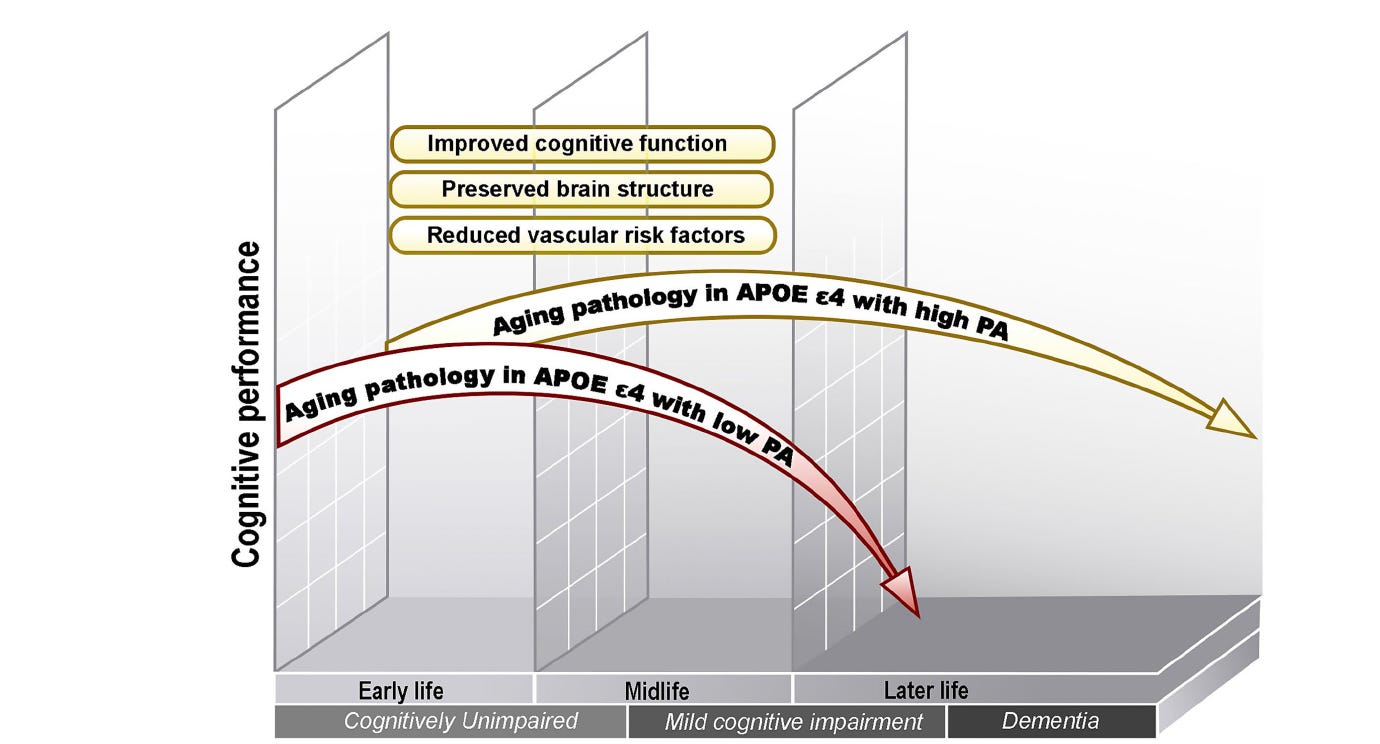
Figure 1. A hypothetical model of protective effects of physical activity (PA) on age-related pathology in APOE ε4 carriers across the lifespan, from Ali et al, 2026 (1).
None of this proves that exercise prevents Alzheimer’s disease in APOE4 carriers.
But together, the studies suggest something worth taking seriously:
Inactivity may be a particularly bad environment for an APOE4 brain.
Why Trials Have Been Disappointing
The trial evidence has not yet matched the observational signal.
That does not mean exercise does not work.
It may mean we have not tested it in the right way.
Many trials enrolled people who already had MCI or dementia. At that stage, the brain may already have substantial synaptic loss, hippocampal atrophy, vascular injury, amyloid, tau, and inflammation. Exercise may still help function, sleep, mood, mobility, falls, and vascular health. But it may be harder to show cognitive rescue.
Some trials were also too small to test APOE4 subgroups properly. Others used broad cognitive tests that may be too blunt. Some measured physical activity by self-report. Some did not prove that fitness actually improved.
A better trial would enroll low-active APOE4 carriers before dementia begins. It would measure movement objectively. It would test whether fitness improves. It would focus on outcomes that exercise is likely to change first: blood pressure, insulin resistance, lipids, inflammation, sleep, cerebral blood flow, hippocampal structure, and blood biomarkers such as p-tau217.
Dementia prevention trials are hard because dementia takes years to develop.
So we need smarter intermediate outcomes.
What Does Sedentary Mean?
Sedentary does not mean lazy.
Sedentary means spending too much waking time sitting, reclining, or lying down with very low energy use.
A practical definition is this:
You sit most of the day, get little intentional movement, and rarely reach moderate-intensity activity.
Many people under about 5,000 steps per day are functionally low-active. But step count does not capture everything. You can reach a decent number of steps and still sit for long blocks.
That matters.
My colleague at USC, David Raichlen, led an analysis of a large cohort that linked sedentary behaviors and dementia risk. This UK Biobank study used wrist accelerometers to measure sedentary behavior in nearly 50,000 older adults. Dementia risk began to rise after about 10 hours per day of sedentary time. Compared with about 9.3 hours per day, risk was higher at 10 hours, much higher at 12 hours, and highest at 15 hours [9].
This does not prove that sitting alone causes dementia.
But it tells us something practical:
The total time spent sedentary matters.
For people who work behind a computer, 10 hours can happen easily: eight hours of work, commuting, meals, and evening screen time.
So the first exercise prescription may not be “join a gym.”
It may be:
Stop letting the chair win the whole day.
The Benefit Is Not Linear
One of the most important ideas in exercise science is also one of the most encouraging:
The benefit is not linear.
Going from sedentary to somewhat active may matter more than going from active to perfectly optimized.
This is good news.
It means the first steps count. The first walk counts. The first week of interrupting long sitting counts. The goal is not to become an athlete. The goal is to stop giving the body a signal of stillness all day long.
For a sedentary person, the first meaningful intervention is often simple:
Move out of the sedentary category.
A person who goes from 3,000 to 6,000 steps per day may gain more biologically than a person who goes from 10,000 to 14,000 steps per day. A person who interrupts sitting every hour may change their daily metabolic pattern even without joining a gym.
This does not mean higher fitness is useless. Fitness matters. Strength matters. Vigorous activity can be valuable.
But the priority is not optimization.
The priority is restoring movement to the day.
A Gym Session Does Not Cancel a Sedentary Day
There is another trap.
Someone may exercise for 45 minutes in the morning and then sit behind a computer for 8 to 10 hours.
That is better than not exercising.
But it does not fully solve the problem.
We were not built to move once and then remain still all day. Human physiology expects repeated muscle contraction, posture change, walking, lifting, bending, carrying, and light movement across the day.
A workout is a dose.
A movement pattern is an environment.
For brain health, the environment may matter as much as the dose.
So the question is not only:
Did I exercise today?
It is also:
How long did I sit without interruption?
How often did I move during the day?
Did my muscles wake up after meals?
Did I spend the whole day in a chair?
This is especially relevant for computer work. A desk job can quietly create 10 hours of sedentary time: work, meetings, commuting, meals, and evening screens.
That is why the practical goal is not only more exercise.
It is less uninterrupted sitting.
Exercise Is Not Just Exercise
When people hear “exercise,” they picture a gym.
But physical activity is broader.
It includes walking to the store, gardening, climbing stairs, cleaning, carrying groceries, dancing, walking after meals, playing with grandchildren, standing from the floor, taking a sunset stroll, and breaking up long sitting time.
Structured exercise matters.
Habitual movement matters too.
The body does not care whether movement came from a gym or from daily lifestyle. It cares that the muscles worked, the heart responded, the blood moved, and the pattern repeated.
The best plan is usually both:
Daily movement plus structured training.
The First Target: Interrupt Sitting
If you are sedentary, the first goal is not VO2 max.
The first goal is to break up long sitting.
Try this:
Every 30 to 60 minutes, stand up and move for 2 to 5 minutes.
Walk around the room.
Climb one flight of stairs.
Do 10 body-weight squats.
Stretch your hips and calves.
Carry laundry.
Water plants.
Walk outside for sunlight.
Take a phone call standing or walking.
These small breaks look unimpressive.
But they repeatedly activate muscle, blood flow, glucose handling, and posture throughout the day.
A single workout is good. A day with repeated movement is better.
Ordinary Movement Counts
Physical activity does not have to look like exercise.
A good hike counts.
Walking the extra distance from the parking lot to the store counts.
Taking the stairs counts.
A morning stroll counts.
A sunset walk counts.
Stretching during the workday counts.
Gardening, cleaning, carrying groceries, walking the dog, dancing, and playing with grandchildren count.
These are not inferior forms of movement. They are the kind of movement human lifestyle used to contain by default.
The body does not care whether movement came from a gym, a trail, a sidewalk, a garden, or a grocery store parking lot.
It cares that the muscles worked, the heart responded, the blood moved, and the pattern repeated.
The goal is not to optimize a workout. The goal is to build a lifestyle the brain can live in.
Steps: Useful, Not Sacred
Steps are a simple way to measure daily movement.
You do not need a wearable, but a phone, watch, ring, or simple pedometer can help you see your baseline.
Measure one normal week.
If you average 3,000 steps per day, aim for 3,500 to 4,000.
If you average 5,000, aim for 6,000.
If you average 7,000, make it consistent.
The first goal is not 10,000 steps.
The first goal is more than your current normal.
For many adults, 7,000 to 10,000 steps per day is a reasonable long-term range. But the biggest gain may come from moving out of the lowest activity category.
A useful rule:
Increase gradually, then make it boringly consistent.
The Walk After Meals
One of the simplest habits is a 10-minute walk after meals.
This is especially useful after lunch or dinner, when blood sugar often rises, and people are likely to sit.
Walking after meals does not require a gym. It does not require special clothes. It does not require motivation for a full workout.
It just requires standing up and going outside.
For APOE4 carriers, this habit makes biological sense because exercise may act through vascular and metabolic pathways: glucose handling, insulin sensitivity, triglycerides, blood pressure, inflammation, and blood flow.
A walk after meals is small enough to repeat.
That is why it works.
The Morning or Sunset Stroll
Not every walk has to be a workout.
An early morning or sunset stroll can combine movement, light exposure, stress reduction, and rhythm.
Morning light helps anchor circadian timing. Evening walks can reduce stress and prevent the drift into hours of sitting after dinner.
These walks may not raise VO2 max dramatically.
That is not the point.
They help build the daily pattern.
And the pattern is the intervention.
Stretching Has a Role
Stretching is not a substitute for aerobic exercise or strength training.
But it helps people move.
Tight hips, stiff ankles, back pain, and poor balance all make activity harder. A few minutes of stretching during the workday can reduce stiffness and make the next walk more likely.
Try simple movements:
Calf stretch
Hip flexor stretch
Hamstring stretch
Chest opener
Thoracic rotation
Neck and shoulder mobility
Gentle yoga or Tai Chi
The goal is not flexibility for its own sake.
The goal is to keep the body available for movement.
Then Add Structured Exercise
Once daily movement is improving, add structured exercise.
Aim for at least 150 minutes per week of moderate aerobic activity, or 75 minutes per week of vigorous activity, plus two days per week of strength training [10].
Moderate means you can talk, but not sing.
Examples include brisk walking, cycling, swimming, hiking, dancing, rowing, or elliptical training.
The simplest plan:
30 minutes, 5 days per week.
If you are starting low, begin with 10 minutes and build.
A good hike once a week can be a powerful anchor. It adds longer aerobic work, hills, sunlight, balance, and often social connection.
That may be better than thinking of exercise only as something done indoors on a machine.
What About VO2 Max?
VO2 max measures how well your body uses oxygen during hard exercise. It is useful in research, but most people do not need a lab test.
You can track fitness in simpler ways:
Can you walk the same route faster?
Can you climb stairs with less effort?
Can you walk uphill without stopping?
Can you cover more distance in six minutes?
Is your resting heart rate lower than before?
Those are practical fitness markers.
If safe, add short intervals once or twice per week:
Warm up for 5 minutes.
Walk fast for 1 minute.
Walk easy for 2 minutes.
Repeat 4 to 6 times.
Cool down.
You do not need to suffer.
You need to progress.
If you have chest pain, severe shortness of breath, dizziness, heart disease, or uncontrolled blood pressure, talk with a clinician before vigorous exercise.
Strength and Balance
Strength training is not optional after midlife.
Muscle is a metabolic organ. It helps glucose control, balance, bone health, mobility, and independence.
Do strength training two days per week.
Include:
Squat or sit-to-stand
Hip hinge
Push
Pull
Carry
Core stability
Use body weight, resistance bands, machines, dumbbells, or household objects.
You do not need to become a bodybuilder.
You need enough strength to keep moving through daily activities.
For older adults, balance also matters. Falls can change the course of aging. Tai Chi, yoga, heel-to-toe walking, step-ups, single-leg stands, and supervised balance work all count [11].
How Do You Know If It Is Working?
Do not expect your memory test to change after 12 weeks.
Do not expect plasma Alzheimer’s biomarkers to clearly improve after a few months of exercise.
Blood biomarkers such as p-tau217 are promising research tools. Future trials should use them. But they are not yet practical personal feedback tools for exercise.
Look for nearer signals.
Your sitting time is lower.
Your steps are higher.
You walk after meals more often.
Your blood pressure improves.
Your resting heart rate falls.
Your walking pace improves.
Stairs feel easier.
Your sleep becomes more regular.
Your waist changes, even if weight does not.
Your triglycerides fall.
Your HDL rises.
Your glucose or A1c improves.
Your strength improves.
Your balance improves.
Your mood and energy improve.
For APOE4 carriers, LDL cholesterol may or may not fall with exercise alone. LDL is often influenced by genetics, diet, saturated fat intake, body weight, and medication.
That does not mean exercise failed.
It means exercise is one part of the system.
The first win is not a biomarker. The first win is changing the daily pattern.
Does Exercise Work Alone?
Exercise helps, but it does not live alone.
A person who exercises but sleeps poorly, eats a highly processed diet, has untreated sleep apnea, uncontrolled blood pressure, high stress, social isolation, or insulin resistance is still pushing the brain in the wrong direction.
This is not because people need a perfect protocol.
They do not.
It is because biology is a network.
Movement improves glucose handling, blood pressure, sleep, mood, inflammation, and muscle metabolism. Better sleep improves appetite, stress hormones, amyloid clearance, and immune regulation. A healthier diet supports the microbiome, lipids, and inflammation. Social connection lowers chronic stress signaling.
These are not separate boxes.
They reinforce each other.
Exercise may be the best first domino because it often makes the next healthy behavior easier.
Uncertainty
We should be honest.
We do not yet have definitive proof that exercise prevents dementia specifically in APOE4 carriers.
Most favorable evidence comes from observational studies. Active people may differ from inactive people in diet, education, sleep, income, medical care, vascular risk, and social connection.
The trials so far have not settled the question.
But the absence of definitive proof is not the same as evidence of no benefit.
Exercise is biologically plausible, low-cost, and strongly beneficial for systems that matter to the brain: blood vessels, metabolism, muscle, sleep, mood, inflammation, and independence.
For APOE4 carriers, that is enough reason to take it seriously while still asking for better trials.
Take-Home Messages
Exercise for APOE4 is not just gym advice. The goal is to improve the vascular, metabolic, inflammatory, and brain-resilience systems that shape how genetic risk is expressed.
Timing may matter. The most encouraging signals appear earlier in life, before dementia, especially in cognitively unimpaired adults.
The benefit is not linear. Moving from sedentary to somewhat active may matter more than moving from active to highly optimized.
Sitting is its own problem. A morning workout is helpful, but it does not fully erase 8 to 10 hours of uninterrupted sitting.
We are built to move repeatedly. Walking, standing, stretching, carrying groceries, taking stairs, gardening, hiking, and short movement breaks all count.
Steps are useful, not sacred. Measure your baseline if it helps, then increase gradually. The first goal is not 10,000 steps. It is more than your current normal.
Look for near-term wins. Better blood pressure, sleep, glucose control, waist size, triglycerides, HDL, strength, balance, mood, and energy may appear long before any change in memory or Alzheimer’s biomarkers.
Exercise works best as part of a lifestyle pattern. Diet, sleep, blood pressure control, metabolic health, stress reduction, social connection, and cognitive engagement reinforce each other.
Do not overpromise. Exercise is not a guaranteed shield against Alzheimer’s disease.
Do not underuse it either. For APOE4 carriers, becoming a person who moves throughout the day may be one of the most rational places to start.
Citation and Acknowledgment
Ali N, Chakbazof N, Ghasem Pour S, Contreras L, Estrada J, Alexander GE, Raichlen DA, Yassine HN. APOE ε4, physical activity, and the brain: a review of systematic reviews. Frontiers in Aging Neuroscience. 2026;18:1798639. doi:10.3389/fnagi.2026.1798639.
The work was supported in part by the National Institutes of Health/National Institute on Aging, the Alzheimer’s Drug Discovery Foundation, donations from the Vranos and Tiny Foundations and Lynne Nauss, and support to Gene E. Alexander from the Arizona Department of Health Services and the McKnight Brain Research Foundation.
The authors have no conflicts of interest.
References
Ali N, Chakbazof N, Ghasem Pour S, et al. APOE ε4, physical activity, and the brain: a review of systematic reviews. Frontiers in Aging Neuroscience. 2026.
Rovio S, et al. Leisure-time physical activity at midlife and the risk of dementia and Alzheimer’s disease. Lancet Neurology. 2005.
Shih IF, et al. Physical activity modifies the influence of APOE ε4 and type 2 diabetes on dementia and cognitive impairment. Alzheimer’s & Dementia. 2018.
Head D, et al. Exercise engagement as a moderator of APOE effects on amyloid deposition.
Smith JC, et al. Physical activity, APOE ε4, and brain activation during memory processing.
Woodard JL, et al. Physical activity, APOE ε4, hippocampal volume, and cognitive decline.
Deeny SP, et al. Exercise, APOE ε4, and cerebral glucose metabolism.
Raichlen DA, Aslan DH, Sayre MK, et al. Sedentary behavior and incident dementia among older adults. JAMA. 2023;330(10):934–940.
del Pozo Cruz B, Gallardo-Gómez D, del Pozo-Cruz J, Ding D. How many steps a day to reduce the risk of all-cause mortality? A dose-response meta-analysis. Journal of Internal Medicine. 2022;291(4):519–521.
Ekelund U, Tarp J, Steene-Johannessen J, et al. Dose-response associations between accelerometry measured physical activity and sedentary time and all-cause mortality. BMJ. 2019;366:l4570.
This is excellent! The optimism is much appreciated. ApoE4 people need more optimism and less doom and gloom. Unfortunately our culture reinforces sedentary behaviors - commutes, car based neighborhoods, travel, desk jobs, long restaurant meals, etc. I have found ways to offset the cultural bias towards sitting (I do not like sitting, a spine surgeon told me years ago when I had trouble with discs, “the spine does not like sitting”) - when I have to sit for more than 15-20 minutes I do isometric exercise, band work, core and breath work, and also use a blood flow restriction device/ kaatsu cycles.
> An important reminder that not all sedentary time is biologically equivalent. The real question may not be "How long do we sit?" but "What is the brain doing while we sit?" Exercise still matters, but cognitive engagement might be an underappreciated layer of brain health.