


In my clinical practice, I have encountered many APOE4 carriers who have enjoyed long, intellectually demanding careers—as engineers, surgeons, judges, and other professionals. Their accomplishments are not evidence that APOE4 improves cognitive ability. Nevertheless, these encounters have often made me reflect on a broader scientific question: Could APOE4 have biological advantages earlier in life, despite increasing the risk of Alzheimer’s disease decades later?
APOE4 is the strongest common genetic risk factor for late-onset Alzheimer’s disease. Yet it is also the ancestral form of APOE and remains common in human populations worldwide. This raises an intriguing evolutionary question: Why has a genetic variant associated with such substantial risks in old age persisted throughout human history?
Recent studies provide some clues. In Indigenous populations of the Bolivian Amazon, APOE4 has been associated with greater reproductive success. Research in Brazil and Bolivia also suggests that APOE4 may help preserve certain cognitive functions under conditions of repeated infections or high parasite exposure. Other studies have reported possible cognitive advantages earlier in life, although these findings are less consistent.
Together, these observations raise the possibility that APOE4’s effects depend on age and environment—providing advantages under some circumstances while increasing vulnerability to Alzheimer’s disease later in life.
Evolutionary biologists call this possibility antagonistic pleiotropy: when a genetic variant has beneficial effects on some traits or at certain ages, but harmful effects on others.
Could APOE4 be an example of this evolutionary trade-off?
Why hasn’t evolution eliminated APOE4?
APOE4 is not a recently acquired harmful mutation. It is considered the ancestral form of APOE, meaning that an APOE4-like version existed before the more common APOE3 form emerged.
APOE produces apolipoprotein E, a protein involved in transporting cholesterol and other fats. These functions are important throughout life, including during brain development, reproduction, and responses to infection.
As humans migrated out of Africa, they carried APOE4 with them. Today, it remains common in many populations worldwide.
But APOE4 also increases the risk of Alzheimer’s disease, particularly among people carrying two copies and of European ancestry.
Why would evolution allow such a variant to persist?
One answer is that natural selection is especially sensitive to traits that affect survival and reproduction early in life.
A genetic variant that improves the chances of having children could be favored even if it contributes to disease decades later.
This is not proof that APOE4 was preserved by natural selection. Its frequency also reflects its ancestral origin, migration, and chance changes in populations over generations.
Still, several original studies suggest that APOE4 may provide advantages under specific conditions.
Could APOE4 increase fertility?

1: Bolivian Amazon — Tsimane community.
One of the most compelling studies comes from the Tsimane, an Indigenous population living in the Bolivian Amazon.
Many Tsimane communities rely on farming, fishing, hunting, and gathering. In the population studied, access to modern contraception was limited, allowing researchers to investigate fertility under conditions different from those in most industrialized populations.
In 2023, researchers examined 795 Tsimane women, approximately 20% of whom carried APOE4. [1]
They found that women carrying at least one APOE4 allele had approximately 0.3 to 0.5 more children than women carrying APOE3/3.
Women with APOE4 also tended to begin having children approximately 0.8 years earlier, with shorter intervals between births.
Among women carrying two APOE4 copies, estimated differences in the number of children were larger, although that group was small.
These findings are interesting because the study examined actual reproductive outcomes, rather than indirect markers such as hormone levels.
But could this advantage occur elsewhere?
An interaction between fertility and infection rates?
A 2017 study involving 4,311 people in rural Ghana investigated whether APOE4 influenced survival and fertility in an environment where infectious diseases were common. [2]
Researchers compared households using different drinking-water sources.
Water obtained from rivers or open wells was considered a marker of greater potential exposure to infectious pathogens, while water from borehole wells was considered less risky.
Among women older than 40, APOE4 was associated with more children in the group with greater presumed pathogen exposure.
In that subgroup, women carrying one APOE4 copy had approximately one more child, on average, than noncarriers. Women with two copies had an even larger estimated difference.
However, these findings require caution. The subgroup was small, and the researchers used water source as an indirect measure of pathogen exposure rather than testing individual infections.
Importantly, APOE4 was not associated with greater fertility across all women, and the study did not demonstrate a statistically significant survival advantage.
Nevertheless, the findings raise a fascinating possibility:
Could APOE4 have provided reproductive advantages in environments where infectious diseases were common?
If even a modest fertility advantage occurred repeatedly across generations, it could have influenced how frequently APOE4 was inherited.
Could APOE4 help children withstand infections?
Another important clue comes from studies of children living in communities with high rates of diarrheal infections in northeastern Brazil.
Repeated diarrhea during infancy and early childhood can interfere with nutrient absorption, growth, and brain development.
In a 2005 study, researchers examined 72 Brazilian children who had been monitored for diarrheal illnesses since birth. [3]
Among children who experienced frequent diarrhea during their first two years, those carrying APOE4 performed better on certain cognitive tests than children without APOE4 who had experienced similarly frequent infections.
The differences involved tasks measuring processing speed and verbal fluency, including the ability to retrieve words.
A subsequent study involving 123 children provided additional evidence that APOE4 might be associated with more favorable outcomes following heavy early-life diarrheal exposure. [4]
These findings do not establish that APOE4 prevents infection. The children were exposed to infectious illness, but APOE4 appeared to be associated with less cognitive impairment following that exposure.
This introduces an important distinction.
Resistance means avoiding or clearing an infection.
Resilience means maintaining function despite exposure to illness or another biological stress.
The Brazilian studies suggest that APOE4 might sometimes support cognitive resilience during early development.
However, these were relatively small observational studies. They cannot establish whether APOE4 itself was responsible for the differences.
Does APOE4 offer benefits when parasite exposure is high?
The idea of infection-related resilience was explored further in another study of Tsimane adults.
In 2017, researchers examined 372 participants and investigated whether APOE4 interacted with parasite burden to influence cognition. [5]
They found that among adults with evidence of high parasite burden, APOE4 carriers generally performed better on cognitive assessments than noncarriers.
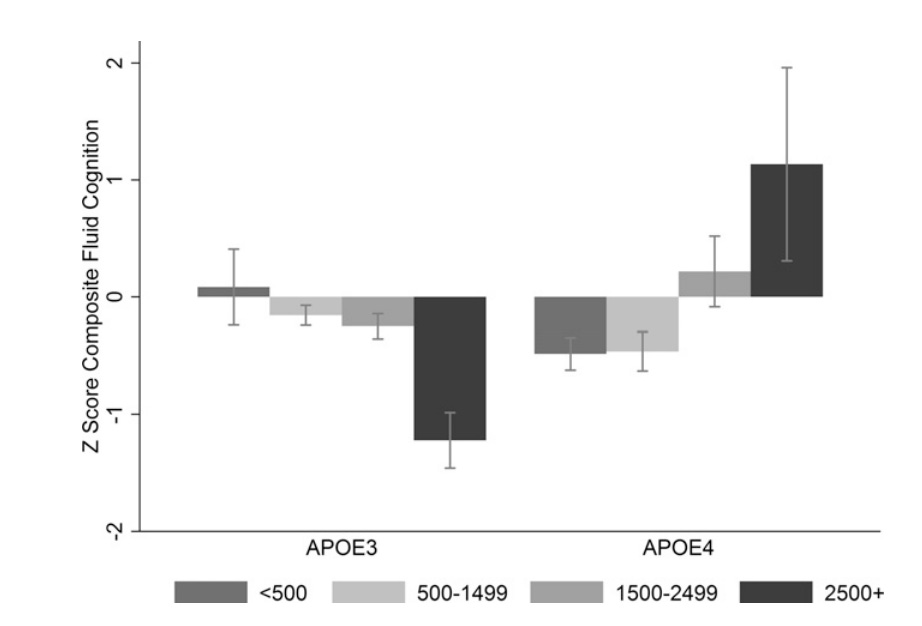
Figure 2. APOE4, parasite burden, and cognitive performance among Tsimané adults in Bolivia. The graph shows predicted cognitive performance in 242 adults aged 30 years and older, comparing APOE4 carriers and noncarriers across four levels of eosinophils. Eosinophils are immune cells that often increase during parasitic infections, so higher counts were used as an indirect indicator of parasite burden. Cognitive performance is expressed as a z-score, where higher values indicate better performance relative to the study’s reference average. The analysis accounted for age, sex, education, Spanish-language ability, and differences between communities.
This suggests that the cognitive effects of APOE4 may depend partly on the environment.
An allele that is disadvantageous in one setting might have different consequences when the body is coping with repeated infections, inflammation, or nutritional challenges.
Again, the study did not establish that APOE4 improves survival or that the observed differences were caused by a particular immune mechanism.
But it provides an intriguing example of how genes and environment can interact.
Is there evidence involving other infections?
A separate study examined APOE variants in people with hepatitis C, a viral infection affecting the liver.
Among 996 individuals with chronic hepatitis C, APOE4 was less frequent than among 179 people who had spontaneously cleared the infection. [6]
APOE4 represented approximately 10% of APOE alleles in chronically infected participants, compared with nearly 18% among those who had cleared the virus.
This association suggests that APOE4 might influence the course of certain infections.
However, it does not mean that APOE4 universally improves immune defense. Its effects likely depend on the pathogen and the biological pathways involved.
The broader message is that APOE4’s consequences may be highly dependent on the circumstances in which it is expressed.
Could APOE4 improve cognition earlier in life?
This brings us back to my patients.
Could APOE4 contribute to better memory or cognitive performance during youth or early adulthood?
Some studies suggest that possibility.
A 2007 investigation of 340 healthy young adults found that APOE4 carriers performed better on tests of episodic memory, the ability to remember specific events and experiences. [7]
In a smaller brain-imaging component, APOE4 carriers also showed evidence of using less brain activity to achieve comparable memory performance.
The researchers interpreted this as potentially greater neural efficiency—the ability to perform a cognitive task with less measurable neural activity.
However, lower or higher brain activation does not automatically mean better cognitive function. Such findings depend on the task and how the brain compensates for different demands.
More recently, a longitudinal study following 5,561 participants over approximately 20 years found that APOE4 heterozygotes performed slightly better on some cognitive measures in midlife, particularly between ages 45 and 55. The advantage was mainly related to executive function, which includes planning, reasoning, and managing complex tasks. [8]
At older ages, however, the direction changed: APOE4 carriers showed greater cognitive decline and higher dementia risk.
A much larger study involving more than 320,000 participants also reported evidence of better cognition at younger ages among female APOE4 carriers, while confirming greater age-related cognitive vulnerability among APOE4 homozygotes. [9]
These findings are certainly intriguing.
But they do not establish that APOE4 generally makes young people more intelligent.
Other studies have found no cognitive advantage, and some have reported less favorable performance in APOE4 carriers. When results across many studies are combined, a consistent early-life cognitive benefit has not been established.
Therefore, I would not conclude that APOE4 explains why an engineer, surgeon, or judge excels professionally.
The more defensible possibility is that APOE4 may influence certain cognitive functions at particular ages or under particular environmental conditions.
And those effects could change as the brain ages.
How can the same gene be beneficial early in life but harmful later?
This brings us to a fundamental concept in evolutionary biology: antagonistic pleiotropy.
The name sounds complicated, but the concept is straightforward.
Pleiotropy means that one gene influences several biological traits.
Antagonistic pleiotropy describes a situation in which the same genetic variant provides an advantage at one stage of life but a disadvantage at another.
APOE4 may be an example.
Earlier in life, APOE4 has been associated in some studies with greater fertility, improved cognitive outcomes under infectious stress, and potentially better performance on selected cognitive tasks.
Later in life, APOE4 increases the risk of Alzheimer’s disease and contributes to cardiovascular risk in some populations.
Why would such a trade-off persist?
Imagine a genetic variant that helps individuals reproduce successfully in their twenties or thirties but increases their risk of dementia after age 70.
From an evolutionary perspective, the early advantage could have a greater effect on how frequently the gene is passed to subsequent generations.
Natural selection does not optimize the brain for a healthy 90-year lifespan. It acts through differences in survival and reproductive success.
This provides a plausible explanation for why APOE4 remains common despite its harmful effects in later life.
But there is an important caveat: APOE4’s benefits and harms have not all been demonstrated within the same people across their entire lifespan.
Thus, antagonistic pleiotropy is an attractive evolutionary explanation, not a fully proven account of APOE4’s persistence.
Does our ancestry change APOE4’s effects?
There is another dimension to this story.
APOE4 is the ancestral form of APOE, but it is not inherited on exactly the same surrounding DNA in everyone.
As humans migrated and populations mixed, different combinations of nearby DNA variants were passed from one generation to the next.
These inherited combinations are called haplotypes.
A person can therefore carry the same APOE4 protein as someone else but inherit it alongside different neighboring genetic variants.
This is related to local ancestry, which describes the ancestral origin of a particular stretch of DNA rather than a person’s ancestry across the whole genome.
In our previous post, we discussed a 2018 study showing that among African American and Puerto Rican participants, APOE4 inherited on an African ancestral DNA background was associated with lower Alzheimer’s risk than APOE4 inherited on a European ancestral background. [10]
This suggests that the surrounding DNA can modify APOE4’s effects.
But we should not assume that the same genetic differences explain fertility, infection-related resilience, and Alzheimer’s risk.
The studies raise two related questions: Does the environment change how APOE4 affects the body? And does inherited DNA modify APOE4’s biological effects?
Both may contribute to understanding why this ancestral allele persists.
What remains uncertain?
The studies discussed here provide intriguing evidence, but they do not demonstrate that APOE4 was maintained by natural selection because it improves fertility, infection outcomes, or cognition.
The strongest reproductive evidence comes from observational studies in specific populations. The Ghanaian fertility association was particularly sensitive to environmental conditions, and the Brazilian childhood studies involved relatively small samples.
The cognitive findings are also inconsistent. Some studies suggest advantages at younger ages, while others find no advantage or even worse performance. Professional achievement has not been established as an APOE4-associated trait.
Similarly, an association with better outcomes during one infection cannot be generalized to all infections. APOE4 may help under certain biological conditions and be harmful under others.
Finally, APOE4 is ancestral. Its persistence does not require that it provides an advantage today. Population history, migration, genetic drift, and the limited effect of diseases appearing after reproduction can all influence how common an allele remains.
Future research will need to identify the mechanisms behind these possible advantages and determine whether they genuinely contributed to human evolutionary history.
Take-home messages
APOE4 is not simply a harmful gene. It has biological effects throughout life, and under specific conditions, some may be beneficial.
Fertility may be one of the strongest clues to its evolutionary persistence. Studies in Bolivia and Ghana associate APOE4 with greater reproductive success in certain populations or environments.
APOE4 may help preserve cognition during infectious stress. Studies in Brazil and Bolivia suggest advantages in people exposed to frequent childhood diarrhea or high parasite burdens.
Early-life cognitive benefits remain uncertain. Some studies report better memory or specific cognitive abilities, but they have not demonstrated a general intelligence advantage.
Antagonistic pleiotropy offers a possible evolutionary explanation. A gene that benefits reproduction or function earlier in life might persist despite increasing disease risk later.
Environment and genetic background both matter. APOE4 may have different biological consequences depending on infection exposure, age, and the DNA inherited alongside it.
Could APOE4 be a trade-off between our evolutionary past and modern aging?
If you carry APOE4, I want you to look at your genetics with a little more appreciation and a lot less fear. APOE4 is not just a risk factor for Alzheimer’s disease. It is part of your evolutionary inheritance.
It may have helped your ancestors survive infections, have children, and thrive in challenging environments. And perhaps some of the qualities that have shaped who you are today have been influenced, in ways we do not yet fully understand, by this same gene copy.
We cannot know how much APOE4 has contributed to any individual’s abilities or accomplishments, but we should not define it only by the disease it may cause decades later.
You are not defined by your Alzheimer’s risk, and carrying APOE4 is not a curse. It is part of your biology and your story.
Our task is not to fear that inheritance, but to understand it, adapt to its vulnerabilities, and make informed choices that help us protect our brains as we grow older.
References
Trumble BC, et al. Apolipoprotein-ε4 is associated with higher fecundity in a natural fertility population. Science Advances. 2023;9:eade9797. https://doi.org/10.1126/sciadv.ade9797
van Exel E, et al. Effect of APOE ε4 allele on survival and fertility in an adverse environment. PLoS ONE. 2017;12:e0179497. https://doi.org/10.1371/journal.pone.0179497
Oriá RB, et al. APOE4 protects the cognitive development in children with heavy diarrhea burdens in Northeast Brazil. Pediatric Research. 2005;57:310–316. https://doi.org/10.1203/01.PDR.0000148719.82468.CA
Oriá RB, et al. ApoE polymorphisms and diarrheal outcomes in Brazilian shanty town children. Brazilian Journal of Medical and Biological Research. 2010;43:249–256. https://doi.org/10.1590/S0100-879X2010007500003
Trumble BC, et al. Apolipoprotein E4 is associated with improved cognitive function in Amazonian forager-horticulturalists with a high parasite burden. FASEB Journal. 2017;31:1508–1515. https://doi.org/10.1096/fj.201601084R
Mueller T, et al. Apolipoprotein E allele frequencies in chronic and self-limited hepatitis C suggest a protective effect of APOE4 in the course of hepatitis C virus infection. Liver International. 2016;36:1267–1274. https://doi.org/10.1111/liv.13094
Mondadori CRA, et al. Better memory and neural efficiency in young apolipoprotein E ε4 carriers. Cerebral Cortex. 2007;17:1934–1947. https://doi.org/10.1093/cercor/bhl103
The association of APOE ε4 with cognitive function over the adult life course and incidence of dementia: 20 years follow-up of the Whitehall II study. 2021. https://pubmed.ncbi.nlm.nih.gov/33397450/
Impact of APOE, Klotho, and sex on cognitive decline with aging. PNAS. 2025. https://pmc.ncbi.nlm.nih.gov/articles/PMC11831164/
Rajabli F, et al. Ancestral origin of ApoE ε4 Alzheimer disease risk in Puerto Rican and African American populations. PLoS Genetics. 2018;14:e1007791. https://doi.org/10.1371/journal.pgen.1007791
Disclosure: This post contains partially AI-assisted text. All references were reviewed for accuracy. I have no relevant conflicts of interest. These opinions are mine and do not reflect the opinions of my employer. The goals of these posts are educational and do not substitute for medical advice.