


A 56-year-old woman recently learned that she carries two copies of APOE4, the strongest common genetic risk factor for late-onset Alzheimer disease.
Both of her grandparents had developed dementia.
She was already doing many of the things we associate with healthy aging. She eats a healthy diet, exercises regularly, does Pilates, and stays socially engaged. Once a week, she meets friends to play games, talk, laugh, and catch up.
At the end of the evening, they often enjoy a glass of wine.
After learning her APOE genotype, she decided to stop drinking alcohol for three months.
Something changed.
Her sleep improved. She could now sleep through the night.
Then she asked me a very practical question:
Can I still have that occasional glass of wine with my friends?
It would be convenient to answer with a number: one drink is fine, two are not, or stay below some number of drinks per week.
Unfortunately, the science is not that precise, particularly for APOE4 carriers.
But that does not mean we have nothing useful to tell her.
We know quite a lot about what alcohol does to the brain. We know that people respond differently to the same amount. We have experimental evidence about alcohol and sleep, and several prospective studies have asked whether APOE4 changes the relationship between alcohol use and subsequent dementia.
Perhaps the most useful question is therefore not simply:
How much alcohol is allowed?
It is:
What does this amount of alcohol actually do to me?
What happens in the brain after a drink?
Alcohol reaches the brain rapidly and changes communication between neurons.
Its actions are complicated, but two neurotransmitter systems help explain many of its immediate effects: GABA and glutamate.
GABA is the major inhibitory neurotransmitter in the brain. Glutamate is the major excitatory neurotransmitter and plays an essential role in learning, memory, and synaptic plasticity.
Alcohol generally shifts this balance toward inhibition. It enhances aspects of GABAergic signaling while suppressing glutamatergic signaling, including signaling through NMDA receptors. It also modifies dopamine and several other neurotransmitter systems involved in reward, attention, memory, and motor control.[1,2]
This helps explain why alcohol can initially produce relaxation and reduced inhibition, followed at increasing doses by slower reaction time, impaired judgment, poorer coordination, and memory problems.
Importantly, the biological effect is not identical from person to person.
Some people notice surprisingly strong sedation or cognitive changes after a small amount of alcohol. Others notice very little.
And feeling different after a drink is not meaningless. It tells us that the central nervous system is responding to that dose, even if the effect would not necessarily be detected by a standard cognitive test.
Alcohol can make us sleepy without helping us sleep well
This may be the most relevant part of the story for this woman.
A recent systematic review and meta-analysis combined 27 experimental studies examining alcohol and subsequent sleep.[3] Alcohol delayed the onset of REM sleep and reduced the amount of REM sleep. These effects became progressively larger as alcohol dose increased.
Changes in REM sleep were detectable even in the investigators’ lower-dose category.
At higher doses, alcohol can shorten the amount of time needed to fall asleep. This probably contributes to the common perception that a drink helps with sleep.
But sedation is not the same as normal restorative sleep.
The review was also appropriately cautious. Results for total sleep time, sleep efficiency, and waking after sleep onset were less consistent.[3] We therefore should not say that one glass of wine inevitably causes nighttime awakening.
That is where individual response becomes important.
If someone sleeps normally after a glass of wine, that tells us one thing.
If someone repeatedly wakes during the night after drinking and sleeps through the night when alcohol is removed, that tells us something different.
The woman who asked me this question had already conducted a useful experiment on herself.
She stopped drinking alcohol for three months.
Her sleep improved substantially.
That does not establish causality. Many things can change during three months. But suppose she reintroduces one glass of wine and again begins waking during the night. Then she avoids wine and sleeps normally. If the pattern repeats, the evidence becomes considerably more compelling.
It is essentially a simple N-of-1 experiment.
The same glass of wine is not necessarily the same biological exposure
Imagine two people who each drink one glass of wine.
One sleeps normally, wakes refreshed, and notices no difference in concentration, coordination, heart rate, or energy.
The other wakes at 2 a.m., sleeps restlessly, feels cognitively foggy the following morning, or notices that her heart is beating faster during the night.
They consumed the same nominal dose.
But their bodies did not respond in the same way.
Population recommendations necessarily average together people who differ in age, sex, body size, alcohol metabolism, medications, liver function, sleep physiology, vascular health, and genetics.
For someone particularly concerned about brain health, I think several responses are worth paying attention to.
Sleep disruption is probably the most useful. If even a small amount of alcohol reproducibly produces fragmented sleep or early awakening, that exposure is clearly not physiologically neutral for that individual.[3]
Feeling cognitively different also matters. Unusual sedation, slowed thinking, poorer concentration, or imbalance tell us that the nervous system is responding to the dose.
Prolonged recovery deserves attention as well. If someone still feels below baseline the following morning after a relatively small exposure, I would not dismiss that simply because the amount consumed falls within a conventional definition of moderate drinking.
There may also be autonomic signals. In a controlled laboratory study of 26 adults aged 30 to 60, evening alcohol increased nighttime heart rate and altered autonomic cardiovascular regulation, with larger effects at higher doses.[4]
None of these responses is a biomarker of Alzheimer's disease.
That distinction is important.
But they do tell us whether an exposure that seems small on paper is actually disrupting normal physiology in that person.
There is also an important asymmetry:
The presence of a reproducible adverse response tells us that the exposure is not neutral. Feeling completely normal after a drink cannot prove that it carries zero long-term risk.
Where does APOE4 fit?
This is where I think APOE4 biology becomes particularly interesting.
I do not think the most useful model is that an APOE4 carrier has a continuously damaged or inflamed brain.
Instead, APOE4 may prime the brain toward greater vulnerability when another stressor is added, as I discussed in my last week's post.
We see hints of this pattern elsewhere.
Last week, I presented data from the Framingham Offspring cohort where APOE4 carriers had lower circulating CRP concentrations than noncarriers, yet when signs of systemic inflammation were present, this was associated with substantially greater Alzheimer risk among APOE4 carriers.[5]
That is an intriguing observation.
APOE4 did not simply produce more baseline inflammation. Rather, the consequences of an inflammatory state appeared different in people carrying APOE4.
This fits a second-hit model.
APOE4 creates susceptibility. Another insult or stress reveals it.
The second hit could be chronic inflammation, vascular disease, metabolic dysfunction, poor sleep, head injury, or potentially repeated alcohol insults.
Alcohol is interesting in this context because it intersects with several pathways affected by APOE4. APOE4 alters lipid handling and membrane biology and has been associated with differences in oxidative and inflammatory responses. Alcohol can perturb neurotransmission, sleep, lipid metabolism, oxidative balance, and inflammatory signaling.[1,2]
The hypothesis, therefore, is not simply that alcohol is inherently toxic to every APOE4 carrier.
It is that an APOE4 brain may respond differently to an additional physiological stressor.
And if alcohol repeatedly disrupts sleep or recovery in a particular APOE4 carrier, that may be especially worth paying attention to.
The epidemiologic question is whether we see evidence of this interaction in humans.
We do, although not consistently.
CAIDE: starting in midlife and looking 23 years later
One of the most informative studies comes from the Finnish CAIDE cohort.[6]
Researchers studied 1,018 people who had originally undergone assessment in midlife. Their mean age at baseline was approximately 48 years. They were reassessed at a mean age of about 72, after approximately 23 years of follow-up.
That long interval is a major strength.
Studies beginning in old age face an important problem: Alzheimer disease develops over many years before dementia is diagnosed. Early disease or declining health could already be causing people to change how much they drink.
Measuring drinking behavior around age 48 reduces, although does not eliminate, that concern.
In CAIDE, the association between drinking frequency and later dementia differed according to APOE4 status. Among APOE4 carriers, dementia risk increased with greater drinking frequency, and the statistical interaction between alcohol use and APOE4 was significant.[6]
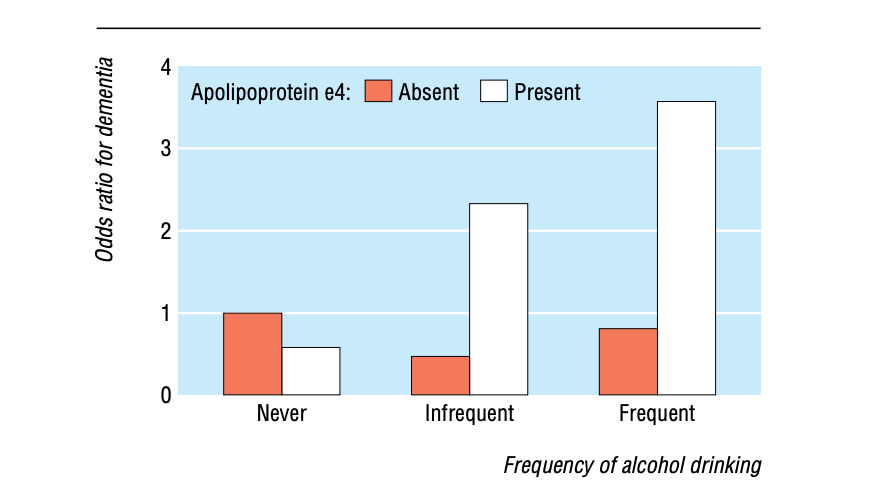
There are important limitations.
Alcohol exposure was self-reported. The number of people became much smaller after dividing the cohort by both genotype and drinking category. And after more than two decades, the people who survived and returned for reassessment were necessarily a selected group.
There is another important detail: “frequent” drinking in CAIDE did not usually mean daily drinking. Most people in that category drank considerably less frequently.
So CAIDE raises an intriguing possibility that APOE4 may modify the consequences of alcohol beginning in midlife.
It does not tell us that one weekly glass causes dementia.
Higher habitual intake raises more concern
Another important study came from the Cardiovascular Health Study.[7]
Mukamal and colleagues compared 373 older adults who developed dementia with 373 matched controls, with approximately six years of follow-up. Participants were largely in their 70s and 80s.
One advantage was that alcohol consumption had been assessed on repeated occasions, and analyses accounted for many demographic and vascular factors.
Among APOE4 carriers, participants reporting 14 or more drinks per week had more than threefold higher odds of dementia compared with abstainers.[7]
But the subgroup was relatively small, which makes the estimate imprecise.
This study therefore tells us more about the potential concern surrounding higher habitual intake than about an occasional glass of wine.
A larger study did not confirm the APOE4 interaction
The story becomes less tidy when we look at another prospective cohort.
Koch and colleagues studied 3,021 dementia-free adults aged 72 or older in the Ginkgo Evaluation of Memory Study.[8] Their median age was 78 years.
During a median follow-up of approximately six years, 512 participants developed dementia.
Participants who already had mild cognitive impairment and consumed more than 14 drinks per week showed greater cognitive decline.
But importantly, APOE4 did not significantly modify the relationship between alcohol and dementia.[8]
That negative result matters.
It means that the APOE4-alcohol interaction seen in some cohorts has not been consistently replicated.
GEMS also has limitations. Alcohol intake was assessed at baseline rather than repeatedly over decades, and a cohort with a median age of 78 is a selected population of older survivors. Its findings may not apply directly to a healthy 56-year-old.
Taken together, these studies support a careful conclusion:
There are reasons to suspect that APOE4 may increase vulnerability to alcohol, but the evidence is not consistent enough to define an APOE4-specific threshold.
So how much is too much?
We do not know.
There is no scientifically established number of drinks per week that is known to be safe specifically for APOE4 carriers.
The literature becomes much more concerning with heavier habitual exposure, including intake of around 14 or more drinks per week in some cohorts.[7,8]
But 14 is not a biological cliff.
Thirteen drinks are not thereby safe and fourteen dangerous.
More importantly for our patient, those studies tell us very little about the difference between zero and one glass of wine per week.
That is exactly where her question sits.
Perhaps recovery matters as much as dose
There is another dimension that weekly totals obscure.
One glass once a week, one glass every night, and seven drinks on Saturday night can all produce very different biological exposures.
Peak alcohol concentration differs.
Effects on sleep differ.
And the time available for physiological recovery differs.
We do not yet know whether recovery from alcohol is systematically different in APOE4 carriers.
But I think the concept is useful because it shifts attention from the drink itself to the person’s response.
Did you sleep normally?
Do you feel cognitively normal?
Are you back to your baseline the next morning?
Those questions do not diagnose brain injury.
They help identify whether the exposure is producing an observable physiological cost.
So what did I tell her?
She had already discovered something important.
She stopped drinking alcohol, and her sleep improved enough that she began sleeping through the night.
I cannot tell her that one glass of wine would accelerate Alzheimer's disease.
We do not have evidence to support that statement.
But if she reintroduces a glass of wine and her nighttime awakenings reliably return, I would view that as meaningful.
For her, the exposure is disrupting sleep.
Given her elevated genetic susceptibility, I see little reason to repeatedly accept a physiological cost when there is no necessity to do so.
And I would strongly encourage her to preserve everything else about that weekly evening:
the friends, the games, the conversation, the laughter, and the social connection.
But maybe the wine is optional? Ok, one glass is ok… who knows!
What remains uncertain
We do not know whether APOE4 homozygotes are more sensitive to a single small dose of alcohol, and at what age or disease stage this becomes detrimental.
We do not know whether alcohol-related sleep disruption translates into greater Alzheimer risk.
We do not know whether once-in-a-while glass changes dementia risk in APOE4 carriers.
And although some prospective studies support an APOE4-alcohol interaction, others do not.[6-8]
Those uncertainties are real and should not be replaced with false precision.
But uncertainty does not mean that an individual’s response is irrelevant.
If removing alcohol produces a substantial improvement in sleep, and reintroducing it reproducibly reverses that improvement, that is useful biological information even if it is not an Alzheimer biomarker.
Take-home messages
Alcohol affects brain function immediately, altering inhibitory and excitatory neurotransmission.[1,2]
Feeling sleepy after alcohol is not the same as sleeping well. Experimental studies show that alcohol alters REM sleep, with greater disruption as dose increases.[3]
People respond differently to the same amount of alcohol. Sleep disruption, cognitive changes, autonomic symptoms, or prolonged recovery are reasonable signals that a dose is not physiologically neutral.[3,4]
APOE4 may be better understood as a vulnerability state than as a fixed abnormal state. Other human data suggest that a second stressor, such as persistent inflammation, can have different consequences in APOE4 carriers.[5]
Alcohol could represent another second hit, but this remains a hypothesis rather than an established mechanism.
Human studies suggest a possible interaction between APOE4 and alcohol, but the results are inconsistent. The strongest studies differ in age, drinking pattern, follow-up, and study design.[6-8]
There is no established safe alcohol threshold specifically for APOE4 carriers.
Higher habitual intake is much more concerning than an occasional single drink. Current epidemiology cannot tell us whether one weekly glass changes dementia risk in an otherwise healthy middle-aged APOE4 homozygote.[6-8]
Individual response can still guide decisions. If stopping alcohol clearly improves sleep and restarting it reliably worsens sleep, that is meaningful information.
For an APOE4 carrier, the question may therefore be less:
“How many drinks am I allowed?”
and more:
“What does this amount of alcohol do to me, and how well do I recover?”
For this woman, her three months without alcohol may already have provided part of the answer.
She sleeps better. That is worth paying attention to.
References
Ron D, Barak S. Molecular mechanisms underlying alcohol-drinking behaviours. Nat Rev Neurosci. 2016;17:576-591. doi:10.1038/nrn.2016.85.
Roberto M, Varodayan FP. Synaptic targets: chronic alcohol actions. Neuropharmacology. 2017;122:85-99. doi:10.1016/j.neuropharm.2017.01.013.
Gardiner C, Weakley J, Burke LM, et al. The effect of alcohol on subsequent sleep in healthy adults: a systematic review and meta-analysis. Sleep Med Rev. 2025;80:102030. doi:10.1016/j.smrv.2024.102030.
de Zambotti M, Willoughby AR, Franzen PL, et al. Impact of evening alcohol consumption on nocturnal autonomic and cardiovascular function in adult men and women: a dose-response laboratory investigation. Sleep. 2021;44(1):zsaa135.
Tao Q, Ang TFA, DeCarli C, et al. Association of chronic low-grade inflammation with risk of Alzheimer disease in ApoE4 carriers. JAMA Netw Open. 2018;1(6):e183597. doi:10.1001/jamanetworkopen.2018.3597.
Anttila T, Helkala EL, Viitanen M, et al. Alcohol drinking in middle age and subsequent risk of mild cognitive impairment and dementia in old age: a prospective population based study. BMJ. 2004;329:539. doi:10.1136/bmj.38181.418958.BE.
Mukamal KJ, Kuller LH, Fitzpatrick AL, Longstreth WT Jr, Mittleman MA, Siscovick DS. Prospective study of alcohol consumption and risk of dementia in older adults. JAMA. 2003;289:1405-1413. doi:10.1001/jama.289.11.1405.
Koch M, Fitzpatrick AL, Rapp SR, et al. Alcohol consumption and risk of dementia and cognitive decline among older adults with or without mild cognitive impairment. JAMA Netw Open. 2019;2(9):e1910319. doi:10.1001/jamanetworkopen.2019.10319.
Disclosure: This post contains partially AI-assisted text. All references were reviewed for accuracy. I have no relevant conflicts of interest. These opinions are mine and do not reflect the opinions of my employer.
As a double APOE4 carrier who lost both parents to FTD, I appreciate your conversation around this topic. My mom was a heavy drinker, especially in midlife but my father was a one drink per week guy. Both of them took stains for years for high cholesterol, had Afib, high stress and sleep apnea issues. I’d like to blame the alcohol to make myself feel like I can control my own personal outcome but I know that is wishful thinking. It’s all about the little choices that add up over time. Please keep sharing your findings. It brings me hope that my outcome could be different from theirs.
Seriously just not worth the risk. How about non alcohol beer? Are there ingredients that are not good for the brain. I do enjoy one of these every so often.