


We’ve heard the message for years: sitting too much is bad for you. It’s been linked to heart disease, diabetes, depression, and yes — dementia. So the advice has generally been to sit less and move more.
But a large new study published in the American Journal of Preventive Medicine adds an interesting wrinkle to that story. It’s not just how long you sit, it suggests. It might be what you’re doing while you’re sitting.
The Study
Researchers followed over 20,000 Swedish adults for nearly 20 years, tracking who developed dementia along the way. What made this study different from previous research is that it distinguished between two types of sedentary behavior:
Mentally passive: TV watching, listening to music, sitting in a bath — activities where your brain is largely in low gear.
Mentally active: Office work, attending meetings, knitting or sewing — activities that require sustained attention, planning, or problem-solving, even if your body isn’t moving.
The question they asked was simple: does it matter which kind of sitting you do?
What They Found
The answer appears to be yes — at least when it comes to the mentally active kind.
People who spent more time in mentally active sedentary behaviors had a measurably lower risk of developing dementia (Table 2). Each additional hour per day of this type of sitting was associated with roughly a 4% reduction in risk, since HR=0.96 means a 4% lower hazard per 60 min/day increment. And when researchers modeled what would happen if people swapped one hour of passive sitting for one hour of mentally active sitting, they found about a 7% reduction in dementia risk with HR=0.93 (95% CI: 0.87–0.99).
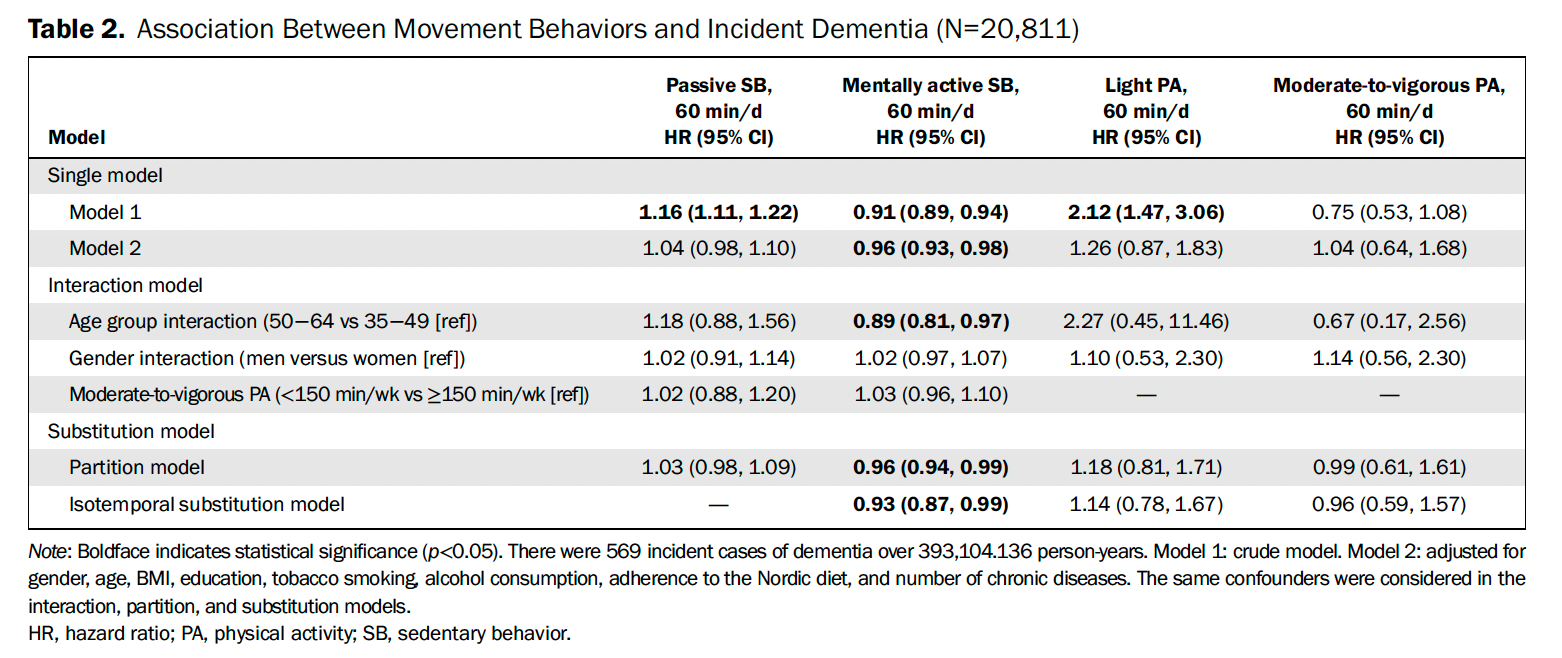
That’s a modest effect, but it was statistically meaningful and held up even after accounting for age, education, smoking, diet, and other factors.
The protective effect was notably stronger among older participants (ages 50–64), which the researchers speculate may be because mentally active behaviors build up what’s called “cognitive reserve” — essentially a buffer of mental resilience that only becomes apparent later in life.
Think of cognitive reserve as a savings account for your brain. Decades of research show that people who accumulate more of it — through education, demanding work, intellectually stimulating leisure, and social engagement — can sustain significantly more physical brain damage before showing clinical symptoms of dementia. Their brains have, in a sense, built alternative routes. A 2024 meta-analysis found that higher cognitive reserve across the life course was consistently associated with reduced dementia risk, and that its benefits compound over time — meaning that what you do in your 40s and 50s may matter as much as, or more than, what you do in your 70s. The catch is that cognitive reserve isn’t something you can bank quickly. It’s built slowly, through years of habits, not months of effort.
What This Doesn’t Mean
Before you swap your gym membership for a puzzle subscription, a few important caveats.
This is observational research. The study can show an association, but it can’t prove that mentally active sitting causes lower dementia risk. It’s possible — and this is a real concern — that people who are already cognitively sharper simply tend to choose more engaging activities. In other words, the direction of causation could run the other way.
The exercise findings are puzzling. Strangely, the study found no significant protective effect from physical activity — even vigorous exercise. That contradicts a mountain of previous research showing PA is one of the strongest dementia protectors we know of. The authors suggest this may be a quirk of how they captured dementia cases (through specialist registers, which miss milder cases). But it’s a flag worth noting: if the model can’t detect a well-known effect, it invites some caution about what it does detect.
The measurement was basic. Sedentary behavior was assessed once, in 1997, using a questionnaire that lumped together very different activities. Knitting and a high-stakes work presentation both counted as “mentally active.” Listening to a podcast and zoning out in front of reality TV both counted as “mentally passive.” The real world is messier than these categories suggest.
19 years is a long time. People’s habits change. The study couldn’t account for how sedentary behavior evolved over two decades of follow-up.
The Elephant in the Room: Your Phone
There’s one glaring gap in this study that researchers and outside experts have been quick to point out: it was designed in 1997, when smartphones didn’t exist, social media hadn’t been invented, and short-form video was science fiction. The passive sedentary behaviors measured back then — TV, music, a long bath — look almost quaint by today’s standards.
Scientists studying dementia and cognitive decline have raised concerns that the kind of passive consumption most of us now do for hours each day — endless scrolling, short-form video, algorithmic feeds designed to hold attention without requiring it — may be doing something more insidious than old-fashioned TV watching. The worry isn’t just that it’s passive. It’s that it may actively train your brain away from the kind of sustained, focused attention that mentally active behaviors depend on.
The idea is that when you spend large amounts of time in a state of passive, low-effort reception — jumping from clip to clip without really concentrating — you may be degrading the very neural pathways you need for concentration, learning, and memory consolidation. The next time you sit down to do something genuinely demanding, your brain has gotten a little worse at it.
Whether this translates into measurable long-term dementia risk is still an open question. The research on “brain rot” and attention spans is early and contested. But the underlying biological logic — that the brain adapts to what it repeatedly does — is well-established. And the sheer volume of passive screen time that now fills daily life dwarfs anything studied in this or most other research.
It’s worth sitting with that for a moment. The study’s data ends in 2016. The TikTok era hadn’t even begun.
Not All Brain Activity Is the Same
Not all “mentally active” activities are equal, and the brain training industry has learned this the hard way. The FTC fined the makers of Lumosity for falsely claiming their games could stave off cognitive decline — because the evidence simply didn’t support it. The core problem is transfer: getting better at a brain-training app mostly makes you better at that app. The skills don’t generalize. What does appear to generalize are activities with genuine complexity, novelty, and depth — learning a new language, picking up a musical instrument, taking up knitting or woodworking. These demand the kind of sustained, layered attention that exercises multiple cognitive systems at once: memory, sequencing, spatial reasoning, problem-solving, and often social engagement too. A crossword is better than scrolling, but learning to play chess or speak conversational Spanish is probably better than a crossword.
The Takeaway
Here’s what the evidence, taken together, suggests:
Type of sitting matters. Mentally active sedentary behavior — work that demands focus, creative hobbies, learning — is associated with lower dementia risk. Passive sitting is not.
Cognitive reserve is built over decades. The habits you build in midlife compound quietly. There is no shortcut.
Brain training apps don’t cut it. The benefit of games like Lumosity doesn’t transfer to real-world cognitive function. Genuine novelty and complexity are what count.
Your phone may be working against you. Passive scrolling and short-form video may erode the very capacity for focused attention that protects the brain. This is speculative but biologically plausible — and the scale of modern screen time is unprecedented.
This is one study with real limits. It can’t prove causation, it missed the smartphone era entirely, and it couldn’t even detect the well-established link between exercise and dementia. Hold the findings with appropriate humility.
The simplest advice still holds. Sit less. Move more. And when you do sit, make it count.
References
Werneck et al., “Mentally Active Versus Passive Sedentary Behavior and Risk of Dementia: 19-Year Cohort Study,” American Journal of Preventive Medicine (2026). https://doi.org/10.1016/j.amepre.2026.108317
Livingston G et al., “Dementia prevention, intervention, and care: 2024 report of the Lancet standing Commission,” The Lancet (2024). https://doi.org/10.1016/S0140-6736(24)01296-0
Fracolli LA et al., “Cognitive reserve over the life course and risk of dementia: a systematic review and meta-analysis,” Frontiers in Aging Neuroscience (2024). https://doi.org/10.3389/fnagi.2024.1358992
“How Cognitive Reserve Could Protect from Dementia? An Analysis of Everyday Activities and Social Behaviors During Lifespan,” Brain Sciences (2025). https://www.mdpi.com/2076-3425/15/6/652
“Brain-training games remain unproven, but research shows what sorts of activities do benefit cognitive functioning,” The Conversation. https://theconversation.com/brain-training-games-remain-unproven-240499
“U.S. Cracking Down on ‘Brain Training’ Games,” Scientific American. https://www.scientificamerican.com/article/u-s-cracking-down-on-brain-training-games/
Xu C et al., “Associations between recreational screen time and brain health in middle-aged and older adults,” J Am Med Dir Assoc (2024). https://doi.org/10.1016/j.jamda.2024.03.010
Fehring D et al., “Changes in prefrontal hemodynamics and mood states during screen use,” Scientific Reports (2025). https://doi.org/10.1038/s41598-025-09360-w
You did a good job of explaining this quirk: “But it’s a flag worth noting: if the model can’t detect a well-known effect, it invites some caution about what it does detect.