


At a recent conference, a middle-aged woman came up to me with a protein bar in her purse.
She was not trying to become a bodybuilder. She was scared of something very real: losing muscle mass as she aged.
She told me she had been aiming for 100 grams of protein per day. She had a relatively small muscle build, but since she started using protein bars — including Maui and David bars — a DEXA scan showed that she had gained muscle mass. She was excited. Understandably so.
Then she asked me the more important question.
Is this actually good for my health?
She admitted that maintaining that level of protein intake was hard. The bars helped her reach the number. But she wanted to know whether chasing 100 grams of protein every day was the right goal for aging.
That is the question this post is really about.
Protein matters. Muscle matters. But aging well is not just about pushing protein intake higher until the number looks right. It is about preserving strength, mobility, metabolic health, gut health, resilience, and independence.
The protein bar may help someone hit a target.
But the bigger question is whether the entire dietary pattern helps the body age well.
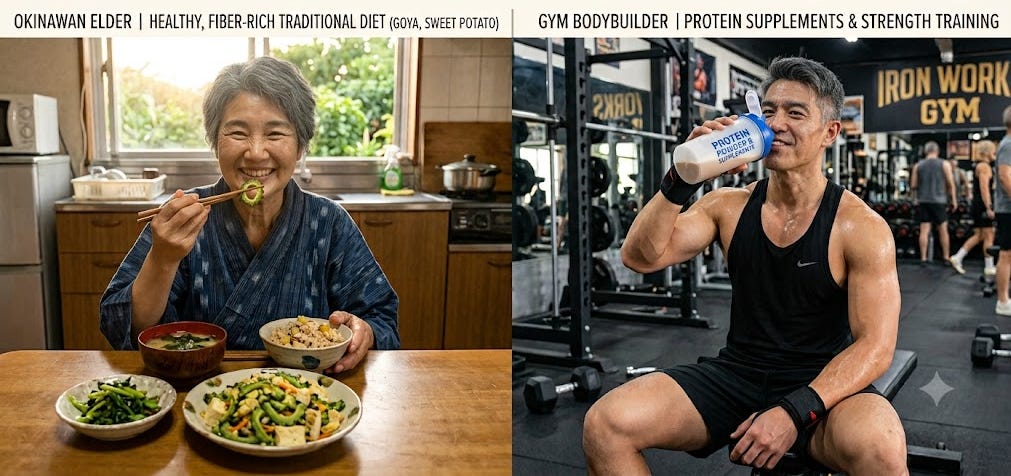
Among those in the image above, who will age better?
The answer is not simply either/or. Strength training matters. Protein matters. But the protein craze often overlooks the bigger question and ends up nutrient-poor.
The Protein Halo
Protein has become the “super nutrient.”
It is added to bars, yogurts, cereals, smoothies, cookies, chips, coffee drinks, and pancake mixes. Once a package says “20 grams of protein,” many people assume it is healthy.
That is the protein halo.
But a high-protein cookie is still a cookie. A protein bar can be useful in a pinch, but it is not the same as a meal built from beans, lentils, yogurt, tofu, fish, eggs, vegetables, nuts, seeds, and whole grains.
The danger is not protein itself.
The danger is using protein as a shortcut for health.
Do We Really Need 100 Grams a Day?
The woman at the conference had absorbed one of the most common messages in wellness culture on social media: aim for 100 grams of protein per day.
But that number is not magic.
Protein needs depend on body size, age, health, appetite, physical activity, total calories, and training goals. The current U.S. Dietary Guidelines for Americans, 2025–2030, now list a protein target of 1.2 to 1.6 grams per kilogram of body weight per day, adjusting as needed for individual caloric requirements. That is a major shift from the older adult RDA of 0.8 grams per kilogram per day, which was designed mainly to prevent deficiency rather than optimize muscle or metabolic function. [1,2].
For a 60 kg person, the current U.S. guideline range of 1.2 to 1.6 g/kg/day translates to about 72 to 96 grams per day. So 100 grams is not wildly outside the new federal target, but it is still not a magic number. For a smaller person, it may be at the high end or above it; for a larger or very active person, it may be reasonable.
Her DEXA scan showed more muscle mass, and that is encouraging. But a DEXA scan does not answer every health question. It does not tell us whether the diet improved insulin sensitivity, vascular health, gut microbial diversity, inflammation, appetite regulation, or long-term resilience.
So the question is not only:
Did the protein target increase lean mass?
It is also:
What did it take to get there, and what did it replace?
If reaching 100 grams requires multiple protein bars, fewer legumes, fewer whole grains, fewer fruits and vegetables, and less dietary variety, then the number may be distracting us from the larger goal.
A protein bar may deliver 20 grams of protein.
But it may deliver little fiber, plant diversity, healthy fat, slow carbohydrate, or microbial fuel.
Whole foods deliver protein inside a broader matrix.
That matrix matters.
The Real Tension: Muscle Versus Longevity Signals
The protein debate in aging has a real tension.
On one side, older adults are often told to eat more protein to preserve muscle and prevent frailty. Some studies support this. In the Health ABC Study, older adults with higher protein intake lost less lean mass over three years than those with lower intake [3].
On the other side, aging biology raises a different concern.
In The Hallmarks of Protein and Amino Acid Restriction in Aging and Longevity, Bailey Knopf and Dudley Lamming review evidence that protein restriction, and restriction of specific amino acids such as methionine, isoleucine, and valine, can improve metabolic health, reduce frailty, extend healthspan, and lengthen lifespan in several model organisms [4].
So which is it?
Do we need more protein for muscle, or less protein for longevity?
The answer is that protein should not be treated as a single lever. Protein affects muscle, but amino acids also act as nutrient signals. They influence pathways that regulate growth, repair, metabolism, inflammation, cellular cleanup, mitochondrial function, and aging.
Protein is not just building material.
Protein is also information that affects metabolism.
That means more is not automatically better. It depends on the person, the dose, the source, the exercise pattern, and the whole diet.
Protein Restriction Biology: Why the Science Is Interesting
The science of protein restriction is not about starving the body of protein.
It is about how the body responds when amino acid availability changes while basic nutritional needs are still met.
Knopf and Lamming describe several hallmarks of protein restriction that overlap with major pathways in aging biology.
One is nutrient sensing. Amino acids regulate mTORC1, a growth-related pathway that helps drive protein synthesis and cell growth when nutrients are abundant. That is useful for building muscle after resistance exercise. But chronically high nutrient signaling may also reduce cellular cleanup processes such as autophagy, which help remove damaged proteins and organelles.
Protein restriction can also activate GCN2, a stress-responsive pathway that helps cells adapt to amino acid scarcity. This is part of a broader shift away from constant growth and toward maintenance, repair, and metabolic adaptation.
Another important signal is FGF21, a hormone induced by protein restriction and some amino acid restrictions. In animal and human studies, FGF21 is linked to changes in energy expenditure, glucose metabolism, lipid handling, and insulin sensitivity.
Protein restriction also intersects with mitochondrial function, cellular senescence, and inflammation. In several models, lower protein or selective amino acid restriction improves metabolic health and reduces markers of aging-related dysfunction. Restriction of specific amino acids, especially methionine and some branched-chain amino acids such as isoleucine and valine, can reproduce some of the benefits of overall protein restriction.
This does not mean people should randomly restrict amino acids.
It means the biology of protein is not simple.
Protein is a muscle nutrient, but amino acids are also signals that tell the body whether to grow, repair, conserve, recycle, or adapt.
Healthspan Is Not Just Muscle Mass
The “more protein” argument often assumes that preserving muscle mass is the same as preventing frailty.
It is not that simple.
Muscle matters, but aging well is about function: strength, balance, walking speed, glucose control, recovery from stress, immune resilience, and independence.
Knopf and Lamming point out that higher protein can promote muscle growth, especially with resistance exercise, but protein restriction can blunt age-related increases in frailty in animal studies. In some late-life models, protein restriction reduced lean mass while also reducing or slowing further declines in frailty [4].
That sounds paradoxical only if muscle size is the only outcome.
The better goal is not maximum muscle at any cost.
The better goal is durable function.
Resilience: The Missing Word
A useful concept in the review is resilience.
Resilience means the ability to bounce back from stress: infection, injury, fasting, heat, cold, hospitalization, inflammation, or metabolic strain.
In humans, loss of resilience contributes to chronic disease, multimorbidity, disability, and death. In animal studies, protein restriction has improved some forms of resilience during aging, including responses to starvation, bacterial infection, and heat stress in fruit flies [4].
We do not yet know how much of this translates to humans.
But the concept is important.
Aging nutrition should not only ask:
How much muscle can I build?
It should also ask:
Can this body recover, adapt, resist disease, and remain independent?
Protein may be part of that answer.
But it is not the whole answer.
Okinawa: A Low-Protein Diet Was Not a Frailty Diet
Okinawa is important because it challenges the assumption that aging well requires protein-maxing.
The traditional Okinawan diet was not built around protein bars, powders, or large portions of animal protein. It was largely plant-based, rich in complex carbohydrates, and centered on foods such as sweet potatoes, vegetables, legumes, and soy. Knopf and Lamming note that the traditional Okinawan diet has been estimated at 9% protein, similar to some protein-restriction laboratory diets, and about 80% of calories from plant sources [4].
This does not prove that low protein caused Okinawan longevity.
The Okinawan pattern also included lower calorie intake, daily movement, social connection, and a broader cultural environment that supported aging.
But that is exactly the point.
Okinawa was not a protein-maximizing culture. It was a dietary and lifestyle pattern. The population became famous for longevity, not frailty.
That should make us cautious about reducing aging nutrition to a single protein target.
The Mediterranean Diet: Muscle Without Protein Obsession
The Mediterranean diet tells a similar story in a more contemporary human study.
Mazza and colleagues studied 528 adults aged 50 and older living in southern Italy and examined dietary patterns in relation to handgrip strength, muscle mass, and sarcopenia [5].
The average participant was not protein deficient. Mean protein intake was about 1.0 g/kg/day.
The researchers identified several dietary patterns. The Mediterranean pattern was characterized by higher intake of carbohydrates, plant proteins, and fiber. People with higher adherence consumed more legumes, cereals, vegetables, and fruit, and lower amounts of meat, fish, and eggs.
This pattern was associated with better handgrip strength and lower prevalence of sarcopenia. Low adherence to the Mediterranean pattern was associated with higher odds of low muscle strength and sarcopenia [5].
This matters because the analyses adjusted for daily protein intake per kilogram of body weight.
So the result was not simply “more protein equals better muscle.”
It was a pattern effect.
The authors make the key point directly: the Mediterranean diet is primarily plant-based, about 20% lower in total protein than a typical Western diet, and relies more on legumes, nuts, seeds, and whole grains as protein sources. They argue that protein quality may be more important than quantity in explaining the benefits of the Mediterranean diet for muscle mass [5].
This helps resolve the protein paradox.
A diet can support muscle without making protein the star.
It can provide adequate amino acids while also delivering fiber, unsaturated fats, polyphenols, minerals, antioxidants, and plant diversity.
The Mediterranean diet is not a low-muscle diet.
It is a food-pattern diet.
Why Protein Bars Miss the Point
A protein bar can deliver 20 grams of protein.
But it cannot deliver a dietary pattern.
It cannot reproduce a meal built from legumes, greens, whole grains, fruit, nuts, seeds, olive oil, yogurt, fish, tofu, herbs, and fermented foods. It cannot compress plant diversity, fiber architecture, resistant starches, polyphenols, minerals, food texture, satiety signals, and microbial substrates into a bar.
This matters for the gut microbiome.
The gut microbiome is shaped by repeated exposure to diverse plant foods. Fibers and polyphenols from legumes, vegetables, fruits, whole grains, nuts, and seeds feed microbial communities that produce metabolites such as short-chain fatty acids. These metabolites influence inflammation, glucose handling, gut barrier function, immune tone, and possibly aging biology.
Protein bars are built around density: more protein in less space.
Healthy aging may depend on the opposite: diversity, structure, and food complexity.
The real question is not, “Did I hit my protein target?”
It is:
What kind of internal ecosystem is this diet building?
The Real Deficiency Is Often Fiber
The modern protein craze has a hidden cost.
When protein goes up, something else often goes down.
For many people, that “something else” is carbohydrate. But carbohydrates are not one thing. Soda and lentils are both carbohydrates. White bread and barley are both carbohydrates. Candy and carrots both contain carbohydrates.
When people cut carbohydrates aggressively to make room for protein, they often cut the foods that feed the gut microbiome: beans, oats, whole grains, fruit, vegetables, potatoes, nuts, and seeds.
That is how a high-protein diet becomes a low-fiber diet.
Fiber supports bowel health, gut microbial diversity, short-chain fatty acid production, cholesterol metabolism, glucose control, satiety, and inflammation.
It is not glamorous. It is not a gym supplement. It does not look sexy on TikTok.
But it may be one of the most important missing nutrients in modern diets.
Muscle Still Needs Training
None of this means protein is irrelevant.
Protein supports muscle repair and adaptation. But resistance exercise is the main signal that tells the body to keep muscle.
Someone can eat a high-protein diet and still lose strength if they do not train. Someone can eat adequate protein from whole foods and preserve muscle if they lift, carry, climb, walk, and remain active.
For aging, muscle protection is a system:
Resistance training + adequate protein + enough calories + fiber-rich plants + sleep + metabolic health + recovery.
Protein is one part of that system.
It should not take over the whole conversation.
The Better Question
Instead of asking:
How do I get more protein?
Ask:
Am I getting enough protein from real foods while also getting enough fiber, plant diversity, healthy fats, and exercise?
That changes the meal.
Greek yogurt becomes Greek yogurt with berries, walnuts, and chia.
Eggs become eggs with greens, mushrooms, and whole-grain toast.
Fish becomes fish with lentils, roasted vegetables, and olive oil.
Tofu becomes tofu with vegetables, sesame, edamame, and brown rice.
Protein stays in the meal.
It just stops being the whole story.
Take-Home Messages
Protein is essential, but more is not always better.
A 100-gram target is not magic. Needs depend on body size, age, health, appetite, activity, and goals.
Protein is both building material and biological signal. Amino acids influence mTOR, GCN2, FGF21, autophagy, mitochondria, senescence, and metabolism.
The frailty argument is more complicated than “eat more protein.” Muscle mass matters, but aging well is about function and resilience.
Okinawa and the Mediterranean diet challenge protein-maxing. These patterns are plant-rich, fiber-rich, and not built around protein density.
Protein quality may matter more than protein quantity.
The gut microbiome needs plant diversity. Fiber, polyphenols, and resistant starches cannot be fully compressed into a bar.
Muscle needs training, not just protein. Resistance exercise is the main signal.
The best target is protein adequacy inside a high-quality dietary pattern.
References
U.S. Department of Agriculture and U.S. Department of Health and Human Services. Dietary Guidelines for Americans, 2025–2030. 10th Edition. January 2026. Available at RealFood.gov.
Bauer J, Biolo G, Cederholm T, et al. Evidence-based recommendations for optimal dietary protein intake in older people: a position paper from the PROT-AGE Study Group. Journal of the American Medical Directors Association. 2013;14(8):542–559.
Houston DK, Nicklas BJ, Ding J, et al. Dietary protein intake is associated with lean mass change in older, community-dwelling adults: the Health ABC Study. American Journal of Clinical Nutrition. 2008;87(1):150–155.
Knopf BA, Lamming DW. The hallmarks of protein and amino acid restriction in aging and longevity. Cell Press Blue. 2026. doi:10.1016/j.cpblue.2026.100079.
Mazza E, Ferro Y, Maurotti S, et al. Association of dietary patterns with sarcopenia in adults aged 50 years and older. European Journal of Nutrition. 2024;63:1651–1662. doi:10.1007/s00394-024-03370-6.
Thanks for this article enshrining our conversation. I'm not 60!! Also I actually try to get much more protein than 100g (120-140g) but I appreciated that you helped me be less tunnel vision about that number. I train with heavy weights 3-4 days per week and I'm also a runner. I also really appreciated your points about the importance of standing up and moving around every 30 minutes or so, and we're adopting that in our house. I eat a ton of cauliflower, broccoli, red peppers, apples and nectarines - we're pro-fiber in our house! I appreciated your point about dense foods and I've taken that on board. I think what this brings up is how important it is to have full context, and public health guidelines on the whole don't and can't tailor themselves to the individuals. I'm bringing this article and some of your others to my physician in the next few weeks for a deeper conversation. Thanks for all your important work, and feel free to correct your article so I'm not charged for the extra decade ;-).
Great post - the protein craze has really gone too far - especially with GLP1 users - and the drop in fiber in these people is especially problematic as gut health deteriorates making them more dependent on these meds and causing more side effects