


A 60-year-old woman recently came to see me for a second opinion.
She carries two copies of APOE4, and her mother developed dementia. Since learning her genotype, she has been doing many of the things we would normally recommend for brain health: exercising regularly, eating a healthy diet, sleeping well, and paying attention to cardiovascular risk.
But she was understandably anxious.
Her neurologist had suggested lithium orotate, 5 mg per day, increasing the dose until she developed side effects. She was hesitant to start it.
Her question was simple:
Should a healthy APOE4/4 carrier take lithium to prevent Alzheimer disease?
Recent work from Liviu Aron, Bruce Yankner, and colleagues has made this an important question to study. Their experiments suggest that naturally occurring lithium may play a role in normal brain aging and that reducing lithium availability can worsen several Alzheimer-related changes in mice.[1]
The biology is intriguing.
But there is still a large gap between discovering an interesting biological pathway and knowing what a healthy 60-year-old should take for the next 20 years.
Lithium is already part of our environment
Most people think of lithium as a medication for bipolar disorder. At those doses, it is a prescription drug, blood levels are monitored, and kidney and thyroid function require surveillance.
But lithium is also a naturally occurring element found in soil, food, and drinking water. Almost everyone consumes small amounts.
That raises an interesting possibility: perhaps lithium has useful physiological effects at concentrations far below those used in psychiatry.
The problem is that we do not know what “enough” lithium means.
Lithium is not officially considered an essential nutrient. There is no recognized human lithium-deficiency syndrome, no recommended daily allowance, and no validated blood test that tells us a healthy person is deficient.[2]
An intake of roughly 1 mg of elemental lithium per day has been proposed as a possible nutritional target, but that was a hypothesis, not a dose proven in clinical trials to prevent disease.[2]
The first clue came from drinking water
One of the best-known observations came from Denmark.
Researchers compared more than 73,000 people with dementia with over 733,000 controls and estimated their long-term exposure to naturally occurring lithium in drinking water.[3]
People exposed to the highest concentrations had lower dementia rates than those in the lowest-exposure group.
But there was a catch.
The relationship was not a simple straight line. Intermediate exposure was not consistently better.
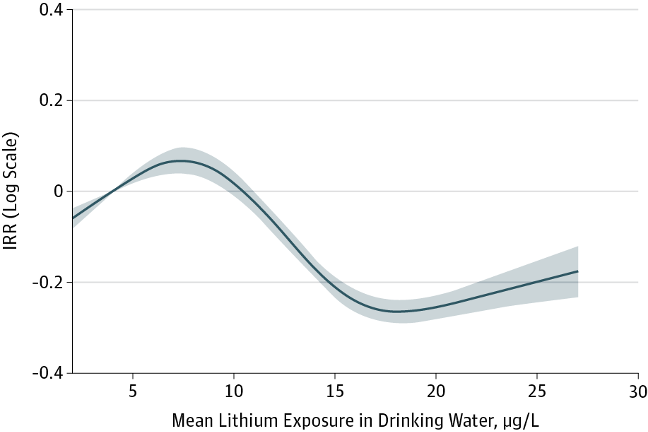
This raises the possibility of a Goldilocks effect. In the children’s story, Goldilocks tastes three bowls of porridge: one is too hot, one is too cold, and one is “just right.” Lithium may eventually behave similarly: too little could be unfavorable, but more is not necessarily better, and very high doses clearly carry risks.
That is important because the epidemiology does not support the idea that progressively increasing lithium should produce progressively greater protection.
The Danish study also cannot prove that lithium caused the lower dementia rate. People living in different areas differ in diet, socioeconomic conditions, healthcare, other minerals in the water, and many other environmental exposures.
So drinking-water studies give us a clue, not a treatment dose.
Where do we get lithium from naturally?
Lithium is present in small amounts in many foods, particularly vegetables and grains. Leafy vegetables appear to be relatively good sources, and older studies found especially high levels in spinach and eggplant.
But lithium content varies greatly with local soil and water, so no reliable food table compares with what we have for calcium or potassium. Drinking water can also make an important contribution in regions where groundwater naturally contains more lithium.
Is U.S. drinking water low in lithium?
There is no single American exposure.
Lithium concentrations vary considerably across U.S. water supplies. Groundwater generally contains more lithium than surface water, and concentrations tend to be higher in some western and central regions.[4,5]
So it would be misleading to say that American water is generally “lithium deficient.”
We do not even know what concentration would define deficiency.
A more recent U.S. population-level analysis also reported an association between higher drinking-water lithium and somewhat lower dementia rates.[6] But again, it compared communities rather than individual people, and the relationship was not simply “more lithium, less dementia.”
The signal is interesting because it has appeared in different populations.
But it remains epidemiology, not proof that lithium prevents Alzheimer disease.
What about reverse-osmosis water?
This is a reasonable practical question.
Conventional water treatment generally leaves much of the lithium intact. Reverse osmosis can remove more than 90% of it.[7]
Someone drinking almost exclusively reverse-osmosis or distilled water could therefore receive substantially less lithium from water.
Does that matter for brain health?
We do not know.
Food also contains lithium, and there is no evidence that people drinking mineral-free water should automatically take lithium supplements.
The numbers are also helpful.
If water contains 10 micrograms of lithium per liter and someone drinks two liters per day, that provides approximately:
0.02 mg of lithium per day.
A 1 mg elemental lithium supplement provides about 50 times that amount.
So we cannot take the drinking-water studies and simply conclude that taking 1 mg, much less 5 mg, reproduces the exposure associated with lower dementia rates.
What Aron, Yankner, and colleagues found in human brains
The Harvard group measured 27 metals in brain tissue from older adults who were cognitively normal, had mild cognitive impairment, or had Alzheimer disease.
Lithium stood out.
It was the only metal significantly reduced in the prefrontal cortex in both MCI and Alzheimer disease. Importantly, blood lithium was not significantly different between the groups.[1]
Then came perhaps the most interesting finding.
Lithium accumulated inside amyloid plaques, while lithium outside those plaques was reduced.
This suggests a possible feedback loop:
amyloid accumulates → lithium becomes trapped → available lithium falls → Alzheimer-related biology may worsen.
But this immediately raises the problem of reverse causation.
Did low lithium contribute to Alzheimer disease?
Or did Alzheimer disease itself lower available lithium by trapping it inside amyloid?
The human data cannot answer that.
And because blood lithium was not reduced, the findings do not support the simple conclusion that people with MCI or Alzheimer disease were consuming too little lithium.
The mouse experiment was striking
The researchers then did something that cannot reasonably be done in people: they deliberately depleted lithium.
They reduced dietary lithium in mice by 92%. Blood lithium fell by about 89%, while available lithium in the cortex fell by roughly half.[1]
The consequences were broad.
Lithium depletion increased amyloid and abnormal tau, activated inflammatory microglia, reduced amyloid clearance, damaged synapses and myelin, and worsened memory.
That provides stronger evidence that lithium itself can influence Alzheimer-related biology.
But there is an important question:
Does a 92% lithium-deficient mouse diet resemble anything that commonly occurs in humans?
We do not know.
The investigators produced a fall in brain lithium similar in magnitude to what they observed in Alzheimer brains, but the cause was different.
In the mice, lithium was removed from food.
In human Alzheimer brains, amyloid itself may have been trapping lithium.
That is a major gap between the animal experiment and clinical practice.
How might lithium affect the brain?
Several mechanisms are plausible.
One involves an enzyme called GSK3β. This enzyme can contribute to abnormal changes in tau, one of the major proteins involved in Alzheimer disease.
Lithium deficiency increased GSK3β activity in the mice. Blocking that enzyme reversed several of the harmful effects, including abnormal tau, amyloid accumulation, and inflammation.[1]
Lithium also affected microglia, the immune cells of the brain. When lithium was depleted, microglia became more inflammatory and less effective at clearing amyloid. Lithium deficiency also changed the activity of several genes associated with Alzheimer risk, including APOE and TREM2.
Another possible pathway involves cPLA2, an enzyme that helps release arachidonic acid from cell membranes. Arachidonic acid can then be converted into inflammatory signaling molecules. Animal studies suggest that chronic lithium can dampen this pathway.[8]
These findings help explain why lithium could matter biologically.
They do not tell us what dose a human should take.
Why lithium orotate?
Aron, Yankner, and colleagues compared several lithium salts.
Lithium orotate showed less binding to amyloid than lithium carbonate in their experimental system. At very low doses, it increased lithium outside plaques and improved amyloid, tau, inflammation, synaptic changes, and memory in mouse models.[1]
The dose is worth emphasizing.
Their lowest exposure corresponded to only 0.03 mg of elemental lithium per liter of drinking water.
The experiment therefore does not show that 5 mg is better than 1 mg, or that higher doses provide more protection.
If anything, the remarkable part of the experiment is that very small exposures appeared biologically active in mice.
What have human trials shown?
The human evidence is much less convincing.
Earlier small trials in people with mild cognitive impairment, or MCI, produced some encouraging signals involving cognition and Alzheimer-related biomarkers.[9,10]
More recently, the LATTICE trial randomized older adults with MCI to lithium carbonate or placebo and followed them for two years.[11]
LATTICE tested low-dose lithium carbonate, but “low dose” here still meant a prescription lithium regimen rather than trace supplementation.
Participants took 150 or 300 mg of lithium carbonate, and among those completing the trial the average dose was about 195 mg/day, producing an average serum lithium concentration of 0.17 mEq/L. This is well below typical bipolar-treatment levels, but it is still a very different exposure from taking 1 mg of elemental lithium as a supplement.
The main result was straightforward:
Lithium did not significantly improve any of the six prespecified primary outcomes.
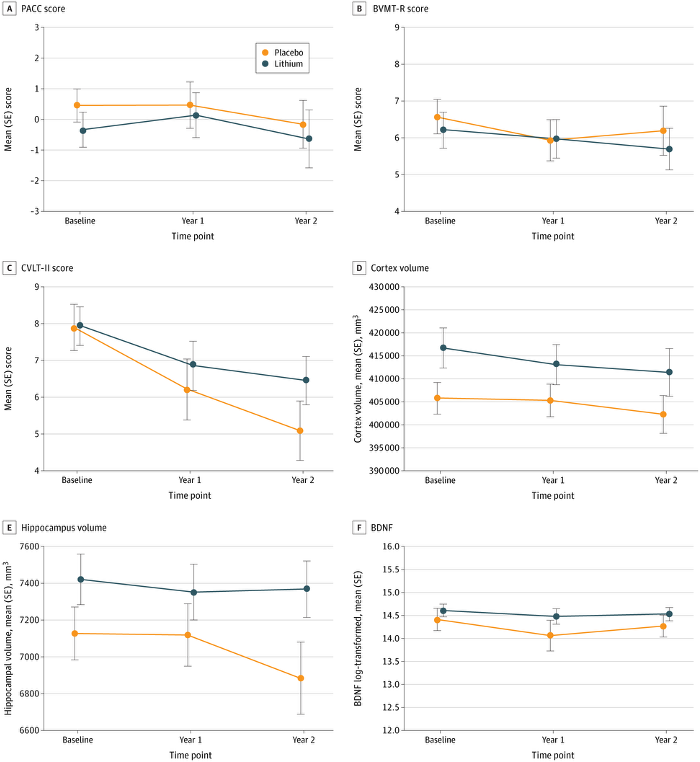
Those outcomes included memory, overall cognition, measures of brain structure, and a blood biomarker.[11]
There was an interesting signal suggesting slower decline on one verbal-memory measure, but it did not meet the study’s stricter statistical threshold after accounting for the multiple outcomes being tested.
So LATTICE was an important negative pilot trial with a possible signal, not evidence that lithium improves cognition.
It also tested a different hypothesis from the new lithium-orotate work.
LATTICE used lithium carbonate and targeted blood concentrations derived largely from psychiatric use. It was testing pharmacological lithium in people who already had MCI.
That is different from asking whether maintaining very low physiological lithium exposure decades earlier might prevent disease.
What do decades of bipolar treatment tell us?
Lithium has been used in bipolar disorder for decades, giving us extensive experience with higher doses.
If lithium were a powerful memory enhancer, we probably would have noticed.
Reviews of bipolar studies show no consistent improvement in memory or overall cognition with lithium.[12]
Some observational studies suggest lower rates of dementia among people treated with lithium, and some imaging studies suggest possible neuroprotective effects.
But neuroprotection is not the same as improving memory, and observational studies can be influenced by differences between patients who do and do not receive lithium.
Again, the evidence does not support the idea that more lithium must be better for the brain.
Why can’t we simply run the definitive prevention trial?
Because we still do not know what dose to test.
Folic acid and neural-tube defects provide a useful contrast.
With folate, supplementation could be given around conception, and the outcome was clear within months: did the baby develop a neural-tube defect or not?[13]
Alzheimer prevention is much harder.
A cognitively healthy 60-year-old APOE4/4 carrier might not develop symptoms for 10 or 20 years.
And before launching a huge trial, we need answers to more basic questions.
How much lithium reaches the human brain after 0.3 mg, 1 mg, or 5 mg?
Does lithium orotate behave differently from lithium carbonate in people?
What dose actually changes the biology we care about?
And how would we know that it is working?
Should an effective dose change amyloid? Tau? Plasma p-tau217? Microglial activity? GSK3β?
At present, we do not have a validated short-term marker showing that trace-dose lithium has engaged the relevant target in a human brain.
This is a PK/PD problem.
PK, or pharmacokinetics, means what the body does to lithium: how much is absorbed, how long it stays in the blood, and how much reaches the brain.
PD, or pharmacodynamics, means what lithium does once it gets there.
Those relationships are well understood for prescription lithium.
They are not established for trace-dose lithium or lithium orotate.
Without that information, even a randomized trial could be difficult to interpret.
If 1 mg failed, was lithium ineffective, or was the dose simply too low?
If 5 mg changed a biomarker, would that biomarker actually predict less dementia 15 years later?
The logical sequence is therefore:
first understand dose and brain exposure, then demonstrate a biological effect, and only then test long-term prevention.
Early human lithium-orotate studies are being developed, including work involving Yankner and collaborators.[14] But these studies will not immediately answer whether a healthy APOE4/4 carrier should take lithium for decades.
Do you need a lithium blood level?
Not to determine whether you are “lithium deficient.”
There is no validated nutritional lithium range.
And in the Aron-Yankner study, brain lithium differed even though blood lithium did not.[1]
So a trace serum lithium level currently cannot tell us whether the brain has enough lithium.
Blood monitoring becomes important at pharmacological doses, where lithium levels are used mainly to reduce the risk of toxicity.
What happens as the dose gets higher?
Here we have decades of experience.
At doses used for bipolar disorder, lithium can cause tremor, nausea, diarrhea, thirst, frequent urination, fatigue, and sometimes cognitive slowing.
Long-term treatment can affect the thyroid, parathyroid glands, and kidneys.
More serious toxicity can cause worsening tremor, persistent vomiting or diarrhea, marked weakness, unusual sleepiness, confusion, slurred speech, poor coordination, seizures, and in severe cases coma.
Dehydration, impaired kidney function, and medications such as NSAIDs, some diuretics, ACE inhibitors, and ARBs can raise lithium levels.
Someone taking lithium who develops significant tremor, persistent gastrointestinal symptoms, confusion, unusual drowsiness, slurred speech, or difficulty walking should stop taking it and seek medical evaluation.
Larger lithium doses should not be used without medical supervision.
Most importantly:
Side effects are not evidence that an Alzheimer-prevention dose has been reached.
There is no scientific basis for increasing lithium until toxicity appears.
Where the uncertainty remains
We still do not know whether low brain lithium is a cause of Alzheimer disease, a consequence of amyloid accumulation, or both.
We do not know whether the severe lithium deficiency created experimentally in mice commonly occurs in humans.
We do not know whether lithium orotate has an important advantage over other lithium salts in people.
We do not know the lowest dose that meaningfully changes Alzheimer-related biology in the human brain.
We do not have a validated short-term marker telling us that low-dose lithium is working.
And most importantly, we do not know whether taking lithium for years prevents cognitive decline in cognitively normal people at genetic risk.
What would I tell an APOE4 carrier who is scared of dementia and wants to take lithium?
This may be the most important part.
Someone who carries APOE4, especially two copies, may reasonably say:
“I understand the evidence is incomplete. But I am frightened of dementia. If a very small dose of lithium seems safe, why shouldn’t I take it?”
That is a fair question.
The first thing I would emphasize is that APOE4 is a risk factor, not a diagnosis. Even APOE4/4 does not mean that dementia is inevitable.
The goal should be to reduce risk without allowing fear of a future disease to create harm in the present.
Lithium is also not an unreasonable molecule to be interested in. There is intriguing epidemiology, plausible biology, strong animal data, and decades of human experience with the drug.
But we still do not know whether lithium prevents Alzheimer disease in cognitively healthy APOE4 carriers.
A 1 mg elemental lithium dose is very different from prescription lithium used for bipolar disorder. The expected risk is likely substantially lower.
But “probably low risk” is not the same as “proven safe and effective for decades.”
And we have no evidence that 1 mg is the correct dose.
For someone who understands those uncertainties and still wishes to try a very-low-dose supplement, I would view that as an individual experimental choice, preferably discussed with a clinician who knows the person’s kidney function, medications, and medical history.
What I would not recommend is progressively increasing the dose in search of greater protection.
Conventional lithium has not produced convincing cognitive benefit in MCI or bipolar disorder.
And higher doses clearly produce more toxicity.
Lithium should also remain in perspective. For an APOE4 carrier, the best-supported strategies remain regular exercise, control of blood pressure and other vascular risks, avoiding smoking, treating hearing loss, maintaining healthy sleep, and addressing diabetes and other metabolic risks when present.
Lithium should not displace those measures simply because it feels more directly connected to Alzheimer biology.
Take-home messages
The lithium-Alzheimer connection is scientifically interesting, but it is not yet clinically proven.
Drinking-water studies suggest an association with dementia, but the relationship may be Goldilocks-like: too little may be unfavorable, while more is not necessarily better.
Low lithium in Alzheimer brain tissue may partly be a consequence of the disease itself, because amyloid appears to trap lithium.
Lithium deficiency worsens Alzheimer-like biology in mice, but the experimental deficiency may not resemble ordinary human exposure.
Lithium orotate performed impressively in mice, but mouse efficacy does not establish a human dose.
LATTICE did not meet any of its six primary outcomes, arguing against assuming that conventional lithium treatment improves cognition in MCI.
A 1 mg elemental lithium supplement is far below psychiatric dosing, but it has not been shown to prevent MCI or dementia.
Blood lithium testing cannot currently diagnose nutritional lithium deficiency.
Higher-dose lithium can cause kidney, thyroid, gastrointestinal, and neurological toxicity.
Escalating lithium until side effects occur is not an evidence-based Alzheimer-prevention strategy.
The next step is to identify the lowest dose that reaches the human brain and demonstrably changes relevant biology, and only then determine whether it prevents cognitive decline.
For a healthy APOE4/4 carrier, lithium orotate remains an intriguing possibility worth studying.
It is not yet a proven prevention therapy, and an individual experimental choice.
References
Aron L, Ngian ZK, Qiu C, et al. Lithium deficiency and the onset of Alzheimer’s disease. Nature. 2025;645:712-720. doi:10.1038/s41586-025-09335-x.
Schrauzer GN. Lithium: occurrence, dietary intakes, nutritional essentiality. J Am Coll Nutr. 2002;21:14-21.
Kessing LV, Gerds TA, Knudsen NN, et al. Association of lithium in drinking water with the incidence of dementia. JAMA Psychiatry. 2017;74:1005-1010.
Lindsey BD, Belitz K, Cravotta CA III, Toccalino PL, Dubrovsky NM. Lithium in groundwater used for drinking-water supply in the United States. Sci Total Environ. 2021;767:144691.
Lithium occurrence in drinking water sources of the United States. Chemosphere. 2022;305:135458.
Hwang SH, Jang H, Park SK, Shin HM. Associations between low-dose drinking water lithium exposure and dementia: a nationwide U.S. ecological study. Environ Pollut. 2026;394:127766.
Keithley AE, Jordan P, Muhlen C, et al. Lithium removal from drinking water. AWWA Water Sci. 2025;7:e70016.
Rao JS, Lee HJ, Rapoport SI, Bazinet RP. Mode of action of mood stabilizers: is the arachidonic acid cascade a common target? Mol Psychiatry. 2008;13:585-596. doi:10.1038/mp.2008.31.
Forlenza OV, Diniz BS, Radanovic M, et al. Disease-modifying properties of long-term lithium treatment for amnestic mild cognitive impairment: randomised controlled trial. Br J Psychiatry. 2011;198:351-356.
Forlenza OV, Radanovic M, Talib LL, Gattaz WF. Clinical and biological effects of long-term lithium treatment in older adults with amnestic mild cognitive impairment: randomised clinical trial. Br J Psychiatry. 2019;215:668-674.
Gildengers AG, Ibrahim TS, Anderson SJ, et al. Low-dose lithium for mild cognitive impairment: a pilot randomized clinical trial. JAMA Neurol. 2026;83:310-319.
Deng R, Shargorodsky A, Teopiz K, et al. Lithium and long-term cognitive outcomes in bipolar disorder and early dementia: a systematic review. CNS Spectr. 2026;31:e18.
Czeizel AE, Dudás I. Prevention of the first occurrence of neural-tube defects by periconceptional vitamin supplementation. N Engl J Med. 1992;327:1832-1835.
Boles S. An Alzheimer’s breakthrough 10 years in the making. Harvard Gazette. January 27, 2026.
Disclosure: This post contains partially AI-assisted text. All references were reviewed for accuracy. I have no relevant conflicts of interest. These opinions are mine and do not reflect the opinions of my employer.