


A reporter recently contacted me while working on a story about the latest evidence on brain games and dementia prevention. Her questions were straightforward: Do these programs actually work? Which types have evidence? Are commercial apps worth paying for?
I realized that, although I often discuss cognitive health and dementia prevention, I had not looked closely enough at the brain training literature itself. So I went back to several landmark experiments, the major cognitive training trials, the newer long-term follow-up data, and the 2026 WHO dementia prevention guideline.
The question is increasingly relevant. Commercial brain training has grown from simple puzzles into a large digital health and wellness industry. Apps commonly promote improvements in memory, attention, processing speed, or general “brain health.” Some have historically made stronger claims about slowing cognitive decline or dementia.
There is good reason to study the idea. The adult brain remains capable of changing with learning, and cognitive training can improve some of the abilities being practiced. But improving performance on a cognitive exercise is not the same as preventing dementia.
So what does cognitive stimulation actually do, how strong is the evidence that it affects dementia risk, and where should it fit within a broader prevention strategy?
The Brain Changes With Learning
The biological rationale for cognitive stimulation begins with neuroplasticity, the brain’s ability to change in response to experience.
One of the best-known demonstrations comes from London taxi drivers. To earn a black cab license, drivers historically had to master “The Knowledge,” an extraordinarily detailed mental map of London involving thousands of streets and landmarks (Fig 1).

This was not simply learning the names of streets. They had to know thousands of roads, landmarks, and routes well enough to mentally calculate efficient journeys between locations without relying on a map.
In a landmark MRI study, Maguire and colleagues found that experienced taxi drivers had more gray matter in the posterior hippocampus, a brain region important for spatial navigation. The longer they had worked as taxi drivers, the greater this difference tended to be. [1]
There was an obvious limitation. Perhaps people with a particular hippocampal anatomy were simply more likely to become successful taxi drivers.
A later longitudinal study addressed this by scanning trainees before they had mastered The Knowledge and following them for several years. Those who eventually qualified showed increased posterior hippocampal gray matter. Trainees who did not qualify and control participants did not show the same change. [2]
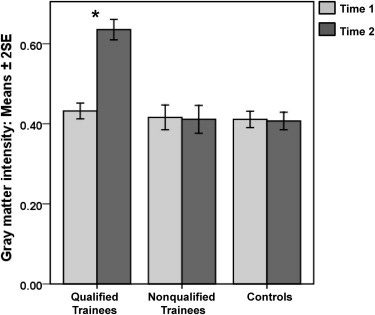
The lesson is important:
The brain adapts to what it repeatedly practices.
That does not mean every aspect of cognition improves. The taxi drivers developed changes in brain systems related to the unusually demanding spatial skill they had spent years acquiring.
Other experiments have found structural brain changes after people learned new motor and visual skills, including in older adults. Neuroplasticity therefore persists into later life.
But neuroplasticity is not the same as dementia prevention. Showing that learning changes the brain does not establish that it reduces amyloid, tau, vascular injury, or neurodegeneration.
Cognitive Reserve
A related concept is cognitive reserve, the capacity to maintain cognitive function despite brain aging or pathology.
The classic Nun Study helped illustrate this idea. Researchers analyzed autobiographies written by Catholic sisters when they were young adults and followed them many decades later. Greater linguistic complexity in early adulthood was associated with better cognition in later life and with differences in Alzheimer related neuropathology at autopsy. [3]
The study did not show that writing complex sentences prevents dementia. Early linguistic ability could reflect education, development, baseline cognitive ability, and other lifelong influences.
Its importance was conceptual: people can differ substantially in how much brain pathology they tolerate before cognitive impairment becomes clinically apparent.
Cognitive stimulation may therefore contribute to resilience without necessarily preventing Alzheimer pathology itself. WHO similarly defines cognitive reserve as the brain’s ability to cope with or compensate for neuropathology or damage and notes that greater education and occupational complexity are associated with lower dementia risk. [4]
Cognitive Stimulation Is Broader Than a Brain Game
WHO distinguishes cognitive training from cognitive stimulation.
Cognitive training generally means repeated exercises targeting specific abilities such as memory, attention, reasoning, or processing speed. Cognitive stimulation is broader and includes reading, learning, games, storytelling, and other intellectually engaging activities. [4]
Social interaction belongs in this discussion too. Conversation requires attention, language, memory, interpretation, and rapid response. Playing a complex game with other people adds strategy, prediction, inhibition, and decision making.
Observational studies consistently associate greater social engagement with lower dementia risk. WHO reports a relative risk of about 0.81, meaning roughly 19% lower observed dementia risk among people with greater social engagement. Randomized social interventions show small cognitive benefits, but they have not demonstrated that increasing social activity prevents dementia. [4]
There is also the problem of reverse causation. Early neurodegenerative disease can cause people to withdraw socially years before dementia is diagnosed. Some of the association between isolation and dementia may therefore reflect early disease rather than isolation causing the disease.
What Do Brain Training Studies Actually Show?
Across the evidence reviewed for its 2026 guideline, WHO concluded that cognitive training produces a small average improvement in cognitive performance, with an effect size called Hedges’ g of approximately 0.25. [4]
Hedges’ g expresses the difference between two groups in standard deviation units. A value of 0.25 means that, on average, the trained group performed about one quarter of a standard deviation better than the comparison group. This is generally considered a small effect.
So brain training can “work” if we mean improving cognitive performance.
The more difficult question is whether improvement extends beyond what was practiced.
Improvement on closely related tasks is sometimes called near transfer. Improvement in more distant abilities, such as driving, managing finances, or maintaining independence, is called far transfer. Evidence for far transfer is less consistent.
The most important question is harder still: does cognitive training actually reduce dementia?
Most cognitive training studies cannot answer that. They typically last weeks or months and measure cognitive test scores rather than dementia incidence. WHO therefore says cognitive training may be offered to older adults with normal cognition or mild cognitive impairment, but the recommendation is conditional and the certainty of evidence is low. [4]
A Long Term Test of Cognitive Training
The ACTIVE trial provides one of the most informative examples. It enrolled 2,802 adults aged 65 and older and randomly assigned them to memory training, reasoning training, processing speed training, or no training. [5]
Memory and reasoning programs taught strategies for those particular abilities.
The processing speed intervention required participants to identify visual information rapidly while also noticing information elsewhere in the visual field.
Processing speed refers to how quickly the brain can take in information and respond.
Divided attention means attending to more than one source of information at the same time.
The training was also adaptive. As someone improved, the exercise became faster or more difficult. Participants therefore continued working close to the limits of their current ability rather than simply repeating a task that had become easy.
Initial training consisted of up to ten 60 to 75 minute sessions over about 5 to 6 weeks. Participants who completed at least eight sessions became eligible for later refresher, or booster, sessions at approximately 11 and 35 months. [6]
There is a reasonable neuroscience rationale for this kind of training. Processing speed depends on distributed systems involved in visual attention, rapid information selection, and cognitive control. Repeated adaptive training may improve the efficiency of these systems.
There was also evidence of some transfer to everyday function. Earlier ACTIVE analyses found that speed training was associated with fewer at fault automobile collisions, an outcome requiring rapid visual processing and attention outside the laboratory. [6]
That makes the intervention interesting. It still does not establish that the training alters Alzheimer pathology.
What Happened Over 20 Years?
A 2026 analysis linked ACTIVE participants to Medicare records through 2019 and examined diagnosed Alzheimer disease and related dementias over approximately 20 years. The analysis included 2,021 participants. [6]
The first finding is important: none of the three original randomized training groups had a statistically significant reduction in dementia diagnoses.
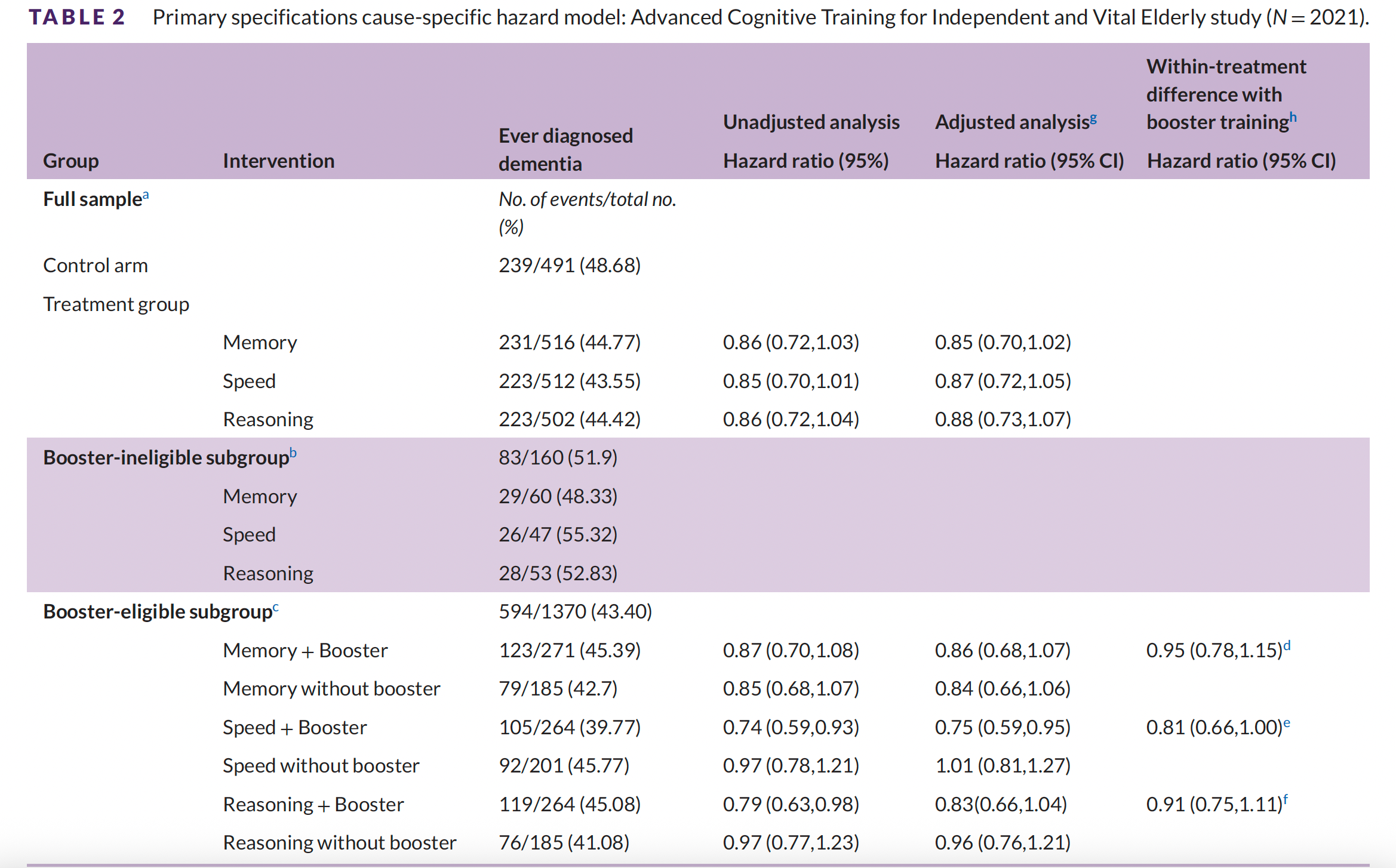
The hazard ratios were 0.85 for memory training, 0.87 for speed training, and 0.88 for reasoning training. In each case, the 95% confidence interval included 1.0. [6]
A hazard ratio, or HR, compares the rate at which an event occurs over time. An HR of 1.0 means no difference between groups. Values below 1.0 favor the intervention.
The 95% confidence interval gives a range of effect sizes reasonably compatible with the observed data. If that interval includes 1.0, the study cannot rule out the possibility that there was actually no difference between the groups and that the observed difference arose from random variation in the sample. By convention, that result is not considered statistically significant.
The notable finding appeared among participants who received speed training plus booster sessions (Table below). Their HR for a dementia diagnosis was 0.75, with a 95% confidence interval of 0.59 to 0.95. In practical terms, the rate of dementia diagnosis during follow-up was about 25% lower than in controls. Because the confidence interval remained below 1.0, the result met the conventional threshold for statistical significance. Speed training without boosters had an HR of 1.01, essentially no difference from controls. [6]
The finding is encouraging, but it needs qualification.
Participants first had to complete most of their initial training before becoming eligible for boosters. This could select people who were healthier, more adherent, or less likely to have subtle early cognitive impairment. Booster assignment among eligible participants was randomized, which reduces this concern but does not eliminate the selection that occurred beforehand. [6]
Dementia was also identified from Medicare diagnostic codes rather than detailed neurological examinations or Alzheimer biomarkers.
The appropriate conclusion is therefore fairly narrow: repeated adaptive processing speed and divided attention training has encouraging long term evidence, but this does not establish that cognitive training as a whole prevents dementia.
Should I Pay for a Brain Training App?
For most people, the evidence does not support saying that they need to.
The long-term processing speed findings do not establish that Sudoku, crossword puzzles, memory matching, word games, or collections of unrelated cognitive exercises prevent dementia.
If someone enjoys a brain training app, finds it challenging, and uses it consistently, that is reasonable. But there are many other ways to obtain substantial cognitive stimulation without purchasing a subscription.
What Can I Actually Do?
A useful principle is to choose activities that require continued learning rather than comfortable repetition.
Repetition is important while a skill is being learned. But once an activity becomes highly practiced and automatic, the cognitive demand falls. The evidence points more toward continued challenge than novelty for its own sake.
This is one reason adaptive training is interesting: as performance improves, the difficulty increases. WHO similarly notes that everyday cognitively stimulating activities should ideally remain new or challenging, while acknowledging that the optimal type, frequency, intensity, and duration are still unknown. [4]
A familiar activity can therefore remain cognitively stimulating if it continues to become harder.
Mahjong is one example. It combines visual search, memory, pattern recognition, planning, inhibition, decision-making, and usually social interaction. A randomized study in older adults with mild cognitive impairment found improvements in several cognitive measures after regular Mahjong play. [7] The study was small and short and did not test dementia prevention.
Comparable activities vary across cultures and interests. Chess, Go, bridge, card games, and traditional strategy games can all require sustained attention, planning, memory, and adaptation to other players.
A lifelong chess player does not necessarily need to abandon chess and take up something completely different. Playing stronger opponents, learning unfamiliar openings, or studying more difficult positions can restore the learning challenge.
Learning another language is another example. In a landmark observational study, Bialystok and colleagues reported that lifelong bilingual patients developed dementia symptoms about four years later than monolingual patients. [8] This contributed to the hypothesis that decades of managing two languages might build cognitive reserve through repeated demands on attention and executive control.
But lifelong bilingualism is not randomly assigned, and it is not equivalent to beginning an 11-week language course at age 70. Short randomized language interventions in older adults have generally shown much more modest and inconsistent transfer to other cognitive abilities.
Still, a language course can provide sustained learning, memory retrieval, auditory processing, and social interaction. Progressing from vocabulary exercises to conversation, reading, and increasingly difficult material keeps the task challenging.
Other possibilities include:
learning an instrument or progressing to harder music
taking a class in history, science, art, computing, or another unfamiliar subject
joining a discussion or book group that tackles demanding material
learning photography, painting, woodworking, sewing, coding, or another complex skill
dancing, particularly when learning new sequences and coordinating with others
volunteering in a role that requires planning, communication, and learning new responsibilities
cooking unfamiliar cuisines or learning increasingly complex techniques
The specific activity probably matters less than several common features: it should require attention, learning, problem solving, and enough progression that it does not become entirely automatic.
Activities that involve other people may also combine cognitive stimulation with social engagement.
What We Still Do Not Know
Important uncertainties remain.
We do not know whether cognitive training alters the underlying biology of Alzheimer disease or primarily improves neural efficiency and cognitive reserve.
We do not know how much improvement transfers from a practiced task to everyday function.
We also do not know the optimal type, intensity, or duration of cognitive stimulation, or whether decades of cognitive activity have effects that cannot be reproduced by beginning training later in life.
And no long-term trial has established that one particular game, language, musical activity, educational program, or commercial app is the preferred strategy for preventing dementia.
Take Home Messages
The adult and aging brain remains plastic. Learning can produce measurable changes in brain structure and function.
The brain adapts to what it practices. Improvement on a trained task does not necessarily translate into broad cognitive improvement.
Cognitive training produces small average improvements in cognitive performance, but evidence for dementia prevention remains limited.
A specific form of repeated adaptive processing speed and divided attention training has encouraging long-term evidence, but this cannot be generalized to all brain games.
Most people do not need to pay for a commercial brain training program.
Meaningful cognitive stimulation can come from continued learning, strategy, problem solving, and progressively challenging skills.
Cognitive stimulation is best viewed as one component of a broader dementia risk reduction strategy, alongside physical activity, social engagement, hearing and vision care, and management of vascular and metabolic risk factors.
The practical goal is not to identify the best brain game. It is to maintain a cognitively active life while addressing the other modifiable factors that influence how the brain ages.
References
Maguire EA, Gadian DG, Johnsrude IS, et al. Navigation related structural change in the hippocampi of taxi drivers. Proc Natl Acad Sci USA. 2000;97:4398-4403.
Woollett K, Maguire EA. Acquiring “the Knowledge” of London’s layout drives structural brain changes. Curr Biol. 2011;21:2109-2114.
Snowdon DA, Kemper SJ, Mortimer JA, et al. Linguistic ability in early life and cognitive function and Alzheimer’s disease in late life: findings from the Nun Study. JAMA. 1996;275:528-532.
World Health Organization. Risk Reduction of Cognitive Decline and Dementia: WHO Guidelines. 2nd ed. Geneva: WHO; 2026.
Ball K, Berch DB, Helmers KF, et al. Effects of cognitive training interventions with older adults: a randomized controlled trial. JAMA. 2002;288:2271-2281.
Coe NB, Miller KEM, Sun C, et al. Impact of cognitive training on claims based diagnosed dementia over 20 years: evidence from the ACTIVE study. Alzheimer’s Dement. 2026;12:e70197.
Zhang H, Peng Y, Li C, et al. Playing Mahjong for 12 weeks improved executive function in elderly people with mild cognitive impairment. Front Neurol. 2020;11:178.
Bialystok E, Craik FIM, Freedman M. Bilingualism as a protection against the onset of symptoms of dementia. Neuropsychologia. 2007;45:459-464.
Disclosure: This post contains partially AI-assisted text. All references were reviewed for accuracy. I have no relevant conflicts of interest. These opinions are mine and do not reflect the opinions of my employer.